//Remembering What is Worth Remembering//
None of us can get through life without making serious mistakes. Most of the time we do our best to do what we think is right in an imperfect world, using the scattered pieces of information available to us, trying our hardest to make choices we think will lead to a better future--a future that is always totally unknown and unpredictable. On top of this less than ideal environment for even knowing and understanding what the right decisions to make are, our countless imperfections, our engrained impulses, our baser instincts, our unintentional short-sightedness, and the constant struggle we have within ourselves, often lead us astray. Inherently, "to error is human," and, in fact, all life in existence struggles to the make the best of things in a chaotic world and necessarily makes mistakes along the way. What is more important than the mistakes themselves is that all that can be learned from them, is, and that newfound knowledge is proactively applied to do better in the future.
Nevertheless, we cannot ignore, nor excuse the impact of, those mistakes we make that are excruciatingly painful to others and ourselves, made in our darkest hours, when it seemed there was no light to guide us as our own light had faded in the darkness of the pain and the fear. Though, were we, and those we've loved but deeply hurt, not victims of our own blind humanity in the times we were truly lost? Must we judge the character and value of a person's entire life based solely on their worst errors?
Can we accept that we all share, among a great many other things, the common experience of inducing pain and sorrow we never wanted for ourselves or our loved ones? Can we all agree 'we are not magnificent'--that with all our natural flaws, whether they include in any particular person a mental disorder, disability, or malady, or none at all, we do our best to find a sense of happiness and safety, even if we are looking in all the wrong places? Is it not true that we all abhor living in fear, being controlled by sadness, bitterness, and regret, and that we quite often do things that seem to make us feel better in the moment but leave us just as empty as before? Is it not clear the 'human condition' is an inherent paradox, and to be human is to be a walking, talking paradox of mixed emotions and mental conflict, having only a dim perception of the real world whilst possessing dangerously limitless but immature imagination?
We all want to be loved and remembered fondly, despite the very serious, yet very human blunders we've made. I, for one, believe our best qualities and greatest achievements are the only things of value worth remembering once we are dead and gone...
//"We're Living at the Mercy of the Pain and the Fear Until We Dead It, Forget It, Let It All Disappear"//
"Yeah, yo
This is not the end, this is not the beginning
Just a voice like a riot rocking every revision
But you listen to the tone and the violent rhythm
And though the words sound steady, something empty's within 'em
We say 'Yeah', with fists flying up in the air
Like we're holding onto something that's invisible there
'Cause we're living at the mercy of the pain and the fear
Until we dead it, forget it, let it all disappear (yeah)
Waiting for the end to come, wishing I had strength to stand
This is not what I had planned, it's out of my control
Flying at the speed of light, thoughts were spinning in my head
So many things were left unsaid, it's hard to let you go
I know what it takes to move on, I know how it feels to lie
All I wanna do is trade this life for something new
Holding on to what I haven't got
Sitting in an empty room, trying to forget the past
This was never meant to last, I wish it wasn't so
I know what it takes to move on, I know how it feels to lie
All I wanna do is trade this life for something new
Holding on to what I haven't got
Yo, yeah
What was left when that fire was gone?
I thought it felt right but that right was wrong
All caught up in the eye of the storm
I'm trying to figure out what it's like moving on
And I don't even know what kind of things I said
My mouth kept moving and my mind went dead
So, picking up the pieces now, where to begin?
The hardest part of ending is starting again!
All I wanna do is trade this life for something new
Holding on to what I haven't got
This is not the end, this is not the beginning
Just a voice like a riot rocking every revision
(I'm holding on to what I haven't got)
But you listen to the tone and the violet rhythm
Though the words sound steady, something empty's within 'em
We say 'Yeah', with fists flying up in the air
Like we're holding onto something that's invisible there
(Holding on to what I haven't got)
'Cause we're living at the mercy of the pain and the fear
Until we dead it, forget it, let it all disappear"
Showing posts with label existence. Show all posts
Showing posts with label existence. Show all posts
March 8, 2016

January 19, 2016
My Debut Album: Wise 'Trip' EP
You can listen to the finalized version of my entire album on SoundCloud.
It is also available on iTunes, Spotify, Google Play, Amazon MP3, Deezer, and Rdio!
It is also available on iTunes, Spotify, Google Play, Amazon MP3, Deezer, and Rdio!
Wise 'Trip' EP is a "concept album," falling under the sub-genres of ambient, ambient industrial, and "space music," that provides the listener with a variety of unique mental impressions united by a thread of universal metaphysical concepts concerning life and reality. 'Trip' has a double-meaning: trip, as in a journey; and trip, as in a "head-trip".
My goal has been to create a truly fresh, unique, and rich listening experience, with each song being structured and composed to serve as a musical metaphor for the concepts and feelings I wanted to share. I did not wish to be bound by common song structures in doing so--the structures are defined instead by the concepts themselves.
I have thrown in a mellow, alternative genre "bonus track" I recorded and produced in a little over an hour using a full-featured recording studio. It was intentionally produced to give it an impromptu, "off-the-cuff" performance feel, with every instrumental and vocal track performed by Drake Holliday. He has my thanks for letting me work with him on it, and for letting me share this song.
The lyrics for "Ascendency" were written by Taylor Podkranic. I'm grateful to him for writing them specifically for me, and for how personally meaningful they are to me. I'm further grateful for him transferring copyright ownership of the lyrics over to my record label. All together, a great example of thoughtful altruism.
"Ascendancy" was a song born from a deeply personal struggle I had for many years. The primary concept conveyed musically is of moving from "darkness to light". The lyrics, which have strong ties to the mythology of the Phoenix (and were written for me by my friend Taylor Podkranic), are perfectly complimentary to the musical development of the song. The purpose of the song, as a whole, is to remind and inspire people, who may be in, or at least remember, that in their darkest hour, they can transcend their limits and struggles to be reborn into whoever they wish to be...
"Ascendancy" Lyrics
(Written by Taylor Podkranic)
(Written by Taylor Podkranic)
©2015 Wise 'Trip' Records
[Verse 1]
Broken and beaten,
to the depths of my soul
Sundered and shaken,
will I ever be whole?
(Repeat Verse)
[Chorus 1]
Climbing higher and higher,
fists to the sky
Through the smoke and the fire,
screaming why... why!
Why did I fracture?
Why did I break?
Can I come back together?
What will it take?
No longer that boy
Reborn as a man
Embers burn in my eyes,
and now here I stand
...now here I stand
[Verse 2]
Self-loathing a cancer,
dragging me down
Choking on silence,
what then is the sound?
Of a soul as it's breaking,
as all lies are lost
As new eyes come open,
I know the cost
[Chorus 2]
Climbing higher and higher,
fists to the sky
Through smoke and the fire,
screaming why... why!
Why did I stumble?
Why did I fall?
Am I worth saving?
Am I worth it at all?
The answer is yes!
We deserve one more chance
A shot at redemption
I'm worth more than a glance
...more than a glance
[Bridge]
Because if you watch,
I'll burst into flames,
soar out of my ashes
Remember my name
Suffering can cleanse you,
each trial a gift
Harder, Faster, Stronger,
even mountains may shift
You have the power
Exert your will
Learn from this lesson,
as I am still...
[Final Chorus]
Climbing higher and higher,
fists to the sky
Through the smoke and the fire,
screaming I will not die
Now I can fly,
fists to the sky
I will not die
Now I can... fly...
[Outro]
What is broken,
may be mended... (x7)
January 15, 2016
An Inquiry into the Fundamental Nature of Existence (Reality)
[Although all of the concepts and unifying "Theory of Everything" framework for them have been fully formed, getting it on paper is an ongoing work in progress. I will be regularly updating this post as the book continues to come together. Enjoy, and please comment!]
>>http://bit.ly/1H8ill1<<
Last Updated: 20150629-00:39GMT
>>http://bit.ly/1H8ill1<<
Last Updated: 20150629-00:39GMT
March 15, 2015
Reflections on the Nature of "Living" Systems
[Text below adapted from my college astronomy course discussion contributions:]
//Conditions Supportive of Life//
What conditions does Earth have that seem necessary to support the existence of living organisms? Be specific, and relate these conditions to the history and astronomical context of our planet.
How likely do you think it is that other planets in the universe have, or have had in the past, those conditions that seem necessary to support the existence of living organisms? Explain why you think so.
//Variety Possible in Forms of "Life"//
//Conditions Supportive of Life//
What conditions does Earth have that seem necessary to support the existence of living organisms? Be specific, and relate these conditions to the history and astronomical context of our planet.
Although other combinations of chemical compounds may possibly lead to self-organization, metabolic activity, and replication (and therefore evolution) as xenobiologists are currently studying, the most basic necessities for life in the form we are familiar with, which are provided for on Earth, include:
- The Sun, as a source of electromagnetic energy necessary for photosynthesis and maintaining habitable temperatures on the Earth's surface (i.e. keeping water in its liquid state beyond the Archean Eon, 4.0-2.5 Ga; Note: "Astronomers think that the sun had about 70–75 percent of the present luminosity, yet temperatures appear to have been near modern levels even within 500 Ma of Earth's formation [> 4.04 Ga], which is puzzling (the faint young Sun paradox). The presence of liquid water is evidenced by certain highly deformed gneisses produced by metamorphism of sedimentary protoliths. The equable temperatures may reflect the presence of larger amounts of greenhouse gases than later in the Earth's history. Alternatively, Earth's albedo may have been lower at the time, due to less land area and cloud cover."). Additionally, the Sun's electromagnetic radiation (reduced to a "healthy" level due to the Earth's magnetic field and ozone layer) accelerates evolution by introducing errors in DNA and RNA encoding sequences, a small percentage of which lead to beneficial adaptations [see Genetic Variation].
- A very wide variety of types of elements and molecules from one or more supernovae, (reactants and catalysts) needed for complex chemical reactions, which provided the diverse array of chemical interplay and structures needed for the random creation of biochemical precursor compounds (i.e. amino acids, nucleic acids) necessary for a successful selection of chemically interacting components that could inherently self-organize, self-sustain through metabolic reactions, and replicate (via RNA or simpler precursors such as PNA, GNA, or TNA).
- Liquid water, provided by volcanic activity as well as ice-containing asteroids, meteorites, and proto-planets (particularly during the Late Heavy Bombardment phase of Earth's history, 4.1-3.8 Ga), as a highly efficient medium for the suspension, free movement, and interaction of chemical compounds necessary for the formation of the first organic compounds (by allowing a very high frequency of random encounters of inanimate chemical compounds to occur), and to eventually continue providing cellular life the capacity for homeostasis (via self-containment within a membrane) and the medium in which to carry on cell processes, including metabolic chemical reactions.
- An atmosphere, providing the containment (i.e. avoiding loss into space) of water vapor, a positive pressure environment necessary for cellular life to survive beyond the oceans, and a major source of molecules (such as carbon dioxide and nitrogen) necessary for the metabolic activity of more complex unicellular, and eventually multicellular, organisms utilizing photosynthesis.
How likely do you think it is that other planets in the universe have, or have had in the past, those conditions that seem necessary to support the existence of living organisms? Explain why you think so.
The following quote, which I used part of in my Week 2 discussion about the likelihood of "intelligent" life elsewhere in the universe, provides support for the idea that life must (extrapolating statistically) exist in other locations in the universe because very similar conditions to those on Earth exist in countless other solar systems in the universe:
"The chemistry of life may have begun shortly after the Big Bang, 13.8 billion years ago, during a habitable epoch when the Universe was only 10–17 million years old. According to the panspermia hypothesis, microscopic life—distributed by meteoroids, asteroids and other small Solar System bodies—may exist throughout the universe. Nonetheless, Earth is the only place in the universe known to harbor life. Estimates of habitable zones around other stars, along with the discovery of hundreds of extrasolar planets and new insights into the extreme habitats here on Earth, suggest that there may be many more habitable places in the universe than considered possible until very recently. On 4 November 2013, astronomers reported, based on Kepler space mission data, that there could be as many as 40 billion Earth-sized planets orbiting in the habitable zones of sun-like stars and red dwarf stars within the Milky Way Galaxy. 11 billion of these estimated planets may be orbiting sun-like stars. The nearest such planet may be 12 light-years away, according to the scientists." [https://en.wikipedia.org/wiki/Planetary_habitability]
I personally concur with the panspermia hypothesis, that forms of basic animate matter (i.e. "life" and/or its precursor components) exist throughout the universe. It is quite plausible that Earth was "seeded" with very basic form(s) of animate matter by one or more space bodies entering the Earth's atmosphere during its first billion years or so of existence. On Earth, and on other planetary bodies in the universe with the right conditions, there as a "nursery" environment that permits the development of more complex animate matter and an evolutionary process, through natural selection, providing ever more complex forms of life to develop.
//Variety Possible in Forms of "Life"//
Many people often forget that there is a vast middle-ground of possibilities when it comes to the "variety spectrum" for animate systems. For them there is either little, if any, forms of life beyond our planet or solar system, or there are countless other intelligent species in the universe that are generally very similar in their biochemistry and physiology to homo sapiens. Yet, xenobiologists (and astrobiologists) have made significant progress in the last decade in expanding our realization of the vast variety of forms in which "living" things can potentially exist—forms of animate systems that are not carbon based, use a different molecular liquid besides water to provide an emulsion medium for metabolic-related chemical reactions, and even perhaps "life" that has advanced beyond biochemistry altogether (e.g. self-organized and evolving electromagnetic energy matrices that take full advantage of the significant evolutionary freedom the quantum mechanical characteristics of matter-energy systems provide at the microscopic level (the average photosynthetic efficiency in plants and photosynthetic bacteria is a staggeringly high ≥90-98%^, as compared to our most recent "cutting-edge" advance in solar cell efficiency in the lab of 46.0%, because those biochemical systems provide for the quantum process of photonic energy pathway self-selection called "quantum walk"*).
* "A phenomenon known as quantum walk increases the efficiency of the energy transport of light significantly. In the photosynthetic cell of an algae, bacterium, or plant, there are light-sensitive molecules called chromophores arranged in an antenna-shaped structure named a photocomplex. When a photon is absorbed by a chromophore, it is converted into a quasiparticle referred to as an exciton, which jumps from chromophore to chromophore towards the reaction center of the photocomplex, a collection of molecules that traps its energy in a chemical form that makes it accessible for the cell's metabolism. The particle's wave properties enable it to cover a wider area and try out several possible paths simultaneously, allowing it to instantaneously "choose" the most efficient route, where it will have the highest probability of arriving at its destination in the minimum possible time. Because it takes place at temperatures far higher than quantum phenomena usually occur in, quantum walking is only possible over very short distances, due to obstacles in the form of destructive interference that will come into play. These cause the particle to lose its wave properties for an instant before it regains them once again after it is freed from its locked position through a classic "hop". The distance towards the center is therefore covered in a series of conventional hops and quantum walks." [Source]
^ "Plants 'seen doing quantum physics'"; "Quantum Biology: Better Living Through Quantum Mechanics - The Nature of Reality"; "Quantum coherent energy transfer over varying pathways in single light-harvesting complexes"; "Environment-Assisted Quantum Walks in Energy Transfer of Photosynthetic Complexes"
January 13, 2015
Dichotomy, Unity, and Balance in Nature and Life
//With Respect to the Overall Nature of Existence//
All that exists is inherently a dipolar spectrum that is both "One" and simultaneously "All." It is "One" because everything that exists, exists relative to something else, and everything is interconnected with everything else, thus constituting an undivided whole. Because this undivided spectrum provides for infinite degree between its two opposite "poles" (has no division of 'intervals' along it), it is what is necessary for "All" things to have relative distinction from all other things. For anything to exist it must exist within a construct that provides the "contrast" necessary for any thing's attributes to be mathematically or physically definable; the dipolar spectrum in our universe provides this contrast, which in turn provides the capacity of things to have different attributes and relative relations to everything else.
So prolific and apparent is the dipolar nature of existence, a large group of people formulated the belief system called "Taoism" in which 'all is One whole' yet has internal distinctions ("Yin & Yang") simultaneously. I will provide you with several examples of Yin & Yang features of nature that you are already naturally familiar with: light vs. darkness, order vs. chaos, hot vs. cold, larger scales of space vs. smaller scales of space, past vs. future, mass vs. no mass, higher energy state vs. lower energy state, stronger gravity/acceleration vs. weaker gravity/acceleration, moving closer together vs. moving away from each other, "good" vs. "evil", life (animate) vs. death (inanimate), et cetera. Everything that exists has defining attributes, each of which lie somewhere along and within this dipolar spectrum geometry, whether the attributes being observed are being observed quantitatively (objectively) or qualitatively (subjectively; e.g. based on values and morals, or other form of personal perspective). It is important to reiterate that even though different things or areas within different space-time locations have these relative distinctions from everything else, due to the fact nothing exists separate from all else and that all things are completely interconnected through space-time, quantum probability waveform, and the continuous field of matter-energy content (a.k.a. a 'state' information waveform), there are no distinct thresholds that separate one thing or area of space-time from another; thus, "All is One" by definition. A perfect example of this whole concept is a "fractal," which is infinite in its scalability, has internal distinctions, yet is "One" mathematically-defined construct.
//With Respect to Human Life//
Forgive me if this seems obvious to some of you, but many people seem to seldom actively consider balance in their life, and, largely for this reason, happiness is elusive for them. I would argue that being happy is as dependent on having balance in your life as it is on having the basic necessities of life. Consider a few examples of the dichotomies that exist for humans in their life: time alone vs. time with friends and family, free time vs. productive time, strict parenting vs. lenient parenting, trusting others completely vs. protecting yourself by being paranoid/suspicious, taking care of others at the expense of self vs. devoting yourself to taking care of yourself so much it is at the expense of others, eating too many sweets vs. not enjoying any, explaining the world through logic and mathematics vs. grasping for meaning or purpose through subjective experiences that are beyond the power of reasoning to explain, worrying too much about appearance vs. not taking care of yourself, living up to others' expectations vs. acting solely based on what you believe is right and appropriate, being naive vs. being judgmental, living a very sheltered life vs. constantly exposing yourself to situations with high risk to the point you must struggle to stay alive, always accepting the beliefs of others vs. only valuing your own, et cetera.
I have come to instinctively recognize such dichotomies almost every day of my life for many, many years. Indeed, the duality of the human experience is so frequently apparent to me that I perceive it as being as much a 'law of nature' as gravity. A person who finds or puts themselves too far one way or the other with respect to any aspect of life defined by a dichotomous nature ultimately suffers. Achieving balance is about achieving relative harmony in your life. In the past, I personally did not have balance in my life in many areas, and I suffered continuously because of it—happiness was elusive for me because of that lack of balance and, thus, harmony.
One would think that awareness of this duality in every aspect of our lives would be enough to guide our decisions towards establishing harmony for ourselves. Yet, it is one of humanity's greatest flaws that we constantly struggle with our own selves in trying to follow the "better" path (if we are fortunate enough to recognize it) because of our instinctive impulses, other engrained behaviors, and having to balance our efforts in achieving balance in our own life with helping achieve balance within our society, which often naturally conflict with one another. We often find some excuse, some weak justification, for not taking the path we know deep down, almost subconsciously, to be more beneficial to us and/or society. Why? Is it possible that part of the reason is that we define our existence to some extent through our suffering—that we need suffering as much as happiness to feel alive? Or do we simply not always have the courage to move beyond the status quo? Unfortunately, although I have a great deal of objective knowledge and subjective experience on this topic, I have not come to a complete conclusion about such matters. Maybe the "answer" is inherently different for everyone. What's yours?
January 11, 2015
Wisdom Concerning the 'Self' (from Some of Humanity’s Greatest Minds)
[The following quote's are some of the ones that were compiled by Maria Popova in her article on brainpickings.org :]
Mindfulness in the Present Moment
"I am alarmed when it happens that I have walked a mile into the woods bodily, without getting there in spirit. In my afternoon walk I would fain forget all my morning occupations and my obligations to Society. But it sometimes happens that I cannot easily shake off the village. The thought of some work will run in my head and I am not where my body is — I am out of my senses. In my walks I would fain return to my senses. What business have I in the woods, if I am thinking of something out of the woods?" — Henry David Thoreau ('Walking' - 1861)
"On the Shortness of Life" by Lucius Annaeus Seneca (4 BC – AD 65)
"It is not that we have a short time to live, but that we waste a lot of it. Life is long enough, and a sufficiently generous amount has been given to us for the highest achievements if it were all well invested. But when it is wasted in heedless luxury and spent on no good activity, we are forced at last by death’s final constraint to realize that it has passed away before we knew it was passing. So it is: we are not given a short life but we make it short, and we are not ill-supplied but wasteful of it… Life is long if you know how to use it."
[…]
"You are living as if destined to live for ever; your own frailty never occurs to you; you don’t notice how much time has already passed, but squander it as though you had a full and overflowing supply — though all the while that very day which you are devoting to somebody or something may be your last. You act like mortals in all that you fear, and like immortals in all that you desire… How late it is to begin really to live just when life must end! How stupid to forget our mortality, and put off sensible plans to our fiftieth and sixtieth years, aiming to begin life from a point at which few have arrived!"
[…]
"Putting things off is the biggest waste of life: it snatches away each day as it comes, and denies us the present by promising the future. The greatest obstacle to living is expectancy, which hangs upon tomorrow and loses today. You are arranging what lies in Fortune’s control, and abandoning what lies in yours. What are you looking at? To what goal are you straining? The whole future lies in uncertainty: live immediately."
Knowing Who You Are
"There is a growing apprehension that existence is a rat-race in a trap: living organisms, including people, are merely tubes which put things in at one end and let them out at the other, which both keeps them doing it and in the long run wears them out."
[…]
"We suffer from a hallucination, from a false and distorted sensation of our own existence as living organisms. Most of us have the sensation that 'I myself' is a separate center of feeling and action, living inside and bounded by the physical body — a center which 'confronts' an 'external' world of people and things, making contact through the senses with a universe both alien and strange. Everyday figures of speech reflect this illusion. 'I came into this world.' 'You must face reality.' 'The conquest of nature.'
This feeling of being lonely and very temporary visitors in the universe is in flat contradiction to everything known about man (and all other living organisms) in the sciences. We do not 'come into' this world; we come out of it, as leaves from a tree. As the ocean “waves,” the universe “peoples.” Every individual is an expression of the whole realm of nature, a unique action of the total universe. This fact is rarely, if ever, experienced by most individuals. Even those who know it to be true in theory do not sense or feel it, but continue to be aware of themselves as isolated “egos” inside bags of skin." — Alan Watts ('The Book: On the Taboo Against Knowing Who You Are' - 1966)
The 'Fixed Mindset' vs. the 'Growth Mindset'
"Believing that your qualities are carved in stone — the fixed mindset — creates an urgency to prove yourself over and over. If you have only a certain amount of intelligence, a certain personality, and a certain moral character — well, then you’d better prove that you have a healthy dose of them. It simply wouldn’t do to look or feel deficient in these most basic characteristics.
[…]
"There’s another mindset in which these traits are not simply a hand you’re dealt and have to live with, always trying to convince yourself and others that you have a royal flush when you’re secretly worried it’s a pair of tens. In this mindset, the hand you’re dealt is just the starting point for development. This growth mindset is based on the belief that your basic qualities are things you can cultivate through your efforts. Although people may differ in every which way — in their initial talents and aptitudes, interests, or temperaments — everyone can change and grow through application and experience.
Do people with this mindset believe that anyone can be anything, that anyone with proper motivation or education can become Einstein or Beethoven? No, but they believe that a person’s true potential is unknown (and unknowable); that it’s impossible to foresee what can be accomplished with years of passion, toil, and training." — Carol Dweck ('Mindset: The New Psychology of Success' - 2006)
Never Cease to Ask Questions and Pursue Answers About the Unknown
"By posing the unanswerable questions of meaning, men establish themselves as question-asking beings. Behind all the cognitive questions for which men find answers, there lurk the unanswerable ones that seem entirely idle and have always been denounced as such. It is more than likely that men, if they were ever to lose the appetite for meaning we call thinking and cease to ask unanswerable questions, would lose not only the ability to produce those thought-things that we call works of art but also the capacity to ask all the answerable questions upon which every civilization is founded…
While our thirst for knowledge may be unquenchable because of the immensity of the unknown, the activity itself leaves behind a growing treasure of knowledge that is retained and kept in store by every civilization as part and parcel of its world. The loss of this accumulation and of the technical expertise required to conserve and increase it inevitably spells the end of this particular world." — Hannah Arendt ('The Life of the Mind' - 1978)
On 'Perfectionism'
"Perfectionism is the voice of the oppressor, the enemy of the people. It will keep you cramped and insane your whole life, and it is the main obstacle between you and a shitty first draft.
[…]
Perfectionism is a mean, frozen form of idealism, while messes are the artist’s true friend. What people somehow (inadvertently, I’m sure) forgot to mention when we were children was that we need to make messes in order to find out who we are and why we are here — and, by extension, what we’re supposed to be writing." — Anne Lamott ('Bird by Bird: Some Instructions on Writing and Life' - 1995)
On Evaluating the Validity and Usefulness of a New Idea
"The kit is brought out as a matter of course whenever new ideas are offered for consideration. If the new idea survives examination by the tools in our kit, we grant it warm, although tentative, acceptance. If you’re so inclined, if you don’t want to buy baloney even when it’s reassuring to do so, there are precautions that can be taken; there’s a tried-and-true, consumer-tested method."
[…]
"1. Wherever possible there must be independent confirmation of the “facts.”
2. Encourage substantive debate on the evidence by knowledgeable proponents of all points of view.
3. Arguments from authority carry little weight — “authorities” have made mistakes in the past. They will do so again in the future. Perhaps a better way to say it is that in science there are no authorities; at most, there are experts.
4. Spin more than one hypothesis. If there’s something to be explained, think of all the different ways in which it could be explained. Then think of tests by which you might systematically disprove each of the alternatives. What survives, the hypothesis that resists disproof in this Darwinian selection among “multiple working hypotheses,” has a much better chance of being the right answer than if you had simply run with the first idea that caught your fancy.
5. Try not to get overly attached to a hypothesis just because it’s yours. It’s only a way station in the pursuit of knowledge. Ask yourself why you like the idea. Compare it fairly with the alternatives. See if you can find reasons for rejecting it. If you don’t, others will.
6. Quantify. If whatever it is you’re explaining has some measure, some numerical quantity attached to it, you’ll be much better able to discriminate among competing hypotheses. What is vague and qualitative is open to many explanations. Of course there are truths to be sought in the many qualitative issues we are obliged to confront, but finding them is more challenging.
7. If there’s a chain of argument, every link in the chain must work (including the premise) — not just most of them.
8. Occam’s Razor. This convenient rule-of-thumb urges us when faced with two hypotheses that explain the data equally well to choose the simpler.
9. Always ask whether the hypothesis can be, at least in principle, falsified. Propositions that are untestable, unfalsifiable are not worth much. Consider the grand idea that our Universe and everything in it is just an elementary particle — an electron, say — in a much bigger Cosmos. But if we can never acquire information from outside our Universe, is not the idea incapable of disproof? You must be able to check assertions out. Inveterate skeptics must be given the chance to follow your reasoning, to duplicate your experiments and see if they get the same result." — Carl Sagan (' The Demon-Haunted World: Science as a Candle in the Dark' - 1996)
Get Lost to Find Yourself
"Leave the door open for the unknown, the door into the dark. That’s where the most important things come from, where you yourself came from, and where you will go. Three years ago I was giving a workshop in the Rockies. A student came in bearing a quote from what she said was the pre-Socratic philosopher Meno. It read, “How will you go about finding that thing the nature of which is totally unknown to you?” I copied it down, and it has stayed with me since. The student made big transparent photographs of swimmers underwater and hung them from the ceiling with the light shining through them, so that to walk among them was to have the shadows of swimmers travel across your body in a space that itself came to seem aquatic and mysterious. The question she carried struck me as the basic tactical question in life. The things we want are transformative, and we don’t know or only think we know what is on the other side of that transformation. Love, wisdom, grace, inspiration — how do you go about finding these things that are in some ways about extending the boundaries of the self into unknown territory, about becoming someone else?"
[…]
"How do you calculate upon the unforeseen? It seems to be an art of recognizing the role of the unforeseen, of keeping your balance amid surprises, of collaborating with chance, of recognizing that there are some essential mysteries in the world and thereby a limit to calculation, to plan, to control. To calculate on the unforeseen is perhaps exactly the paradoxical operation that life most requires of us."
[…]
"To lose yourself: a voluptuous surrender, lost in your arms, lost to the world, utterly immersed in what is present so that its surroundings fade away. In Benjamin’s terms, to be lost is to be fully present, and to be fully present is to be capable of being in uncertainty and mystery. And one does not get lost but loses oneself, with the implication that it is a conscious choice, a chosen surrender, a psychic state achievable through geography. That thing the nature of which is totally unknown to you is usually what you need to find, and finding it is a matter of getting lost." — Rebecca Solnit ('A Field Guide to Getting Lost' - 2005)
Be Like Water
"After spending many hours meditating and practicing, I gave up and went sailing alone in a junk. On the sea I thought of all my past training and got mad at myself and punched the water! Right then — at that moment — a thought suddenly struck me; was not this water the very essence of gung fu? Hadn’t this water just now illustrated to me the principle of gung fu? I struck it but it did not suffer hurt. Again I struck it with all of my might — yet it was not wounded! I then tried to grasp a handful of it but this proved impossible. This water, the softest substance in the world, which could be contained in the smallest jar, only seemed weak. In reality, it could penetrate the hardest substance in the world. That was it! I wanted to be like the nature of water.
Suddenly a bird flew by and cast its reflection on the water. Right then I was absorbing myself with the lesson of the water, another mystic sense of hidden meaning revealed itself to me; should not the thoughts and emotions I had when in front of an opponent pass like the reflection of the birds flying over the water? This was exactly what Professor Yip meant by being detached — not being without emotion or feeling, but being one in whom feeling was not sticky or blocked. Therefore in order to control myself I must first accept myself by going with and not against my nature."
[…]
"Water is so fine that it is impossible to grasp a handful of it; strike it, yet it does not suffer hurt; stab it, and it is not wounded; sever it, yet it is not divided. It has no shape of its own but molds itself to the receptacle that contains it. When heated to the state of steam it is invisible but has enough power to split the earth itself. When frozen it crystallizes into a mighty rock. First it is turbulent like Niagara Falls, and then calm like a still pond, fearful like a torrent, and refreshing like a spring on a hot summer’s day." — Bruce Lee ('Bruce Lee: Artist of Life' - 1999)
Making 'Good' Out of 'Evils'
"Throughout our nervous history, we have constructed pyramidic towers of evil, ofttimes in the name of good. Our greed, fear and lasciviousness have enabled us to murder our poets, who are ourselves, to castigate our priests, who are ourselves. The lists of our subversions of the good stretch from before recorded history to this moment. We drop our eyes at the mention of the bloody, torturous Inquisition. Our shoulders sag at the thoughts of African slaves lying spoon-fashion in the filthy hatches of slave-ships, and the subsequent auction blocks upon which were built great fortunes in our country. We turn our heads in bitter shame at the remembrance of Dachau and the other gas ovens, where millions of ourselves were murdered by millions of ourselves. As soon as we are reminded of our actions, more often than not we spend incredible energy trying to forget what we’ve just been reminded of."
[…]
"To show you … how out of evil there can come good, in those five years I read every book in the black school library. I read all the books I could get from the white school library. I memorized James Weldon Johnson, Paul Laurence Dunbar, Countee Cullen and Langston Hughes. I memorized Shakespeare, whole plays, fifty sonnets. I memorized Edgar Allen Poe, all the poetry — never having heard it, I memorized it. I had Longfellow, I had Guy de Maupassant, I had Balzac, Rudyard Kipling — I mean, it was catholic kind of reading, and catholic kind of storing."
[…]
"Out of this evil, which was a dire kind of evil, because rape on the body of a young person more often than not introduces cynicism, and there is nothing quite so tragic as a young cynic, because it means the person has gone from knowing nothing to believing nothing. In my case I was saved in that muteness… And I was able to draw from human thought, human disappointments and triumphs, enough to triumph myself."
[…]
"We need the courage to create ourselves daily, to be bodacious enough to create ourselves daily — as Christians, as Jews, as Muslims, as thinking, caring, laughing, loving human beings. I think that the courage to confront evil and turn it by dint of will into something applicable to the development of our evolution, individually and collectively, is exciting, honorable." — Maya Angelou (Documentary: 'Facing Evil with Maya Angelou' - 1988)
Living by Your Own Standards (the Basis for 'Happiness')
"Happiness is not a goal, it is a by-product. Paradoxically, the one sure way not to be happy is deliberately to map out a way of life in which one would please oneself completely and exclusively. After a short time, a very short time, there would be little that one really enjoyed. For what keeps our interest in life and makes us look forward to tomorrow is giving pleasure to other people."
[…]
"Someone once asked me what I regarded as the three most important requirements for happiness. My answer was: ‘A feeling that you have been honest with yourself and those around you; a feeling that you have done the best you could both in your personal life and in your work; and the ability to love others.’"
[…]
"It’s your life — but only if you make it so. The standards by which you live must be your own standards, your own values, your own convictions in regard to what is right and wrong, what is true and false, what is important and what is trivial. When you adopt the standards and the values of someone else or a community or a pressure group, you surrender your own integrity. You become, to the extent of your surrender, less of a human being." — Eleanor Roosevelt ('You Learn by Living: Eleven Keys for a More Fulfilling Life' - 1960)
December 24, 2014
A Word (or Two...) On the Truths Concerning Existence
[A Forward: from www.truthcontest.com :
"We as conscious beings now have the opportunity to become aware of the truth of Life by way of reason, attention, and honest intention."]
Over the last several years, through exhaustive studies across a multitude of disciplines, I personally discovered real Truth of what God is and is not, about my world, and my self... purpose, meaning, the 'how it works' answers, and 'what it all means', by identifying and recognizing relevant macroscopic and microscopic patterns (e.g. observing fractal "self-similarity" being present in our universe {reference: Chaos Theory}) across a multitude of vary different types of systems and making a final leap--a leap I ultimately had to make with the help of a little bit of "intuition". Ironically, I also learned that all my intellectual toil was not necessary; all along I could have discovered truth through simple subjective, unanalyzed observation and simply 'knowing' (e.g. the Buddhist story about a man smiling, having attained "enlightenment", after a long period of meditating on a flower he sat before):
One Love Unites All; All is God and God is in all--not separate at all (reference: "pantheism"). Your Conscious Mental-State in the "Now"/"Present" Moment is an infinitesimal slice of the omniscient consciousness of God. Every Conscious Being is Both the Cause and Simultaneously the Result of the Universe Being Experienced/'Observed'. All Possible Configurations of the Universe Exist, Always & Forever, within an ∞ Manifold (Even though We are not Able to See it All from Our Limited Perspective as Human Beings). All Information is Saved--Never Lost--because It Always Existed and Always Will. "Past" and "Future" Always Exist--Just as Much as the Present Moment Does (it is Simply the Case that the Nature of Our Limited Consciousness Does Not Allow Us to Experience Anything but the "Present" at any Moment). Nothing Exists as "Physical" objects; Everything is a "Projection" of Universal Consciousness (reference: "panpsychism"), an ∞ Emanation of Light/Energy/Heat/Warmth/Love/Life into the ∞ Manifold of All Existence. Each of Us can Only See an Infinitesimally thin, singularly Unique, Slice of Existence. The State of the "Universe" is Unique to You at Any Given Moment. You Have "Free Will" Only in the Sense that, Subjectively, You Sense You Are "Navigating" which Particular Universe Will Unfold Before You 'this Time' through Your Subjective Perception that you are Choosing the Path that Unfolds Before You (Out of an ∞ Many Other Paths the Other "You's" Are Traveling); Objectively, from a Universal Frame of Reference, You Do Not Have Free Will because an ∞ number of Different Universes are Unfolding for Each of an ∞ Number of "You's." I Realize that I am in ∞ Synchrony/Interconnection with the Rest of Existence, as All Things Are with Each Other. The Purpose of Life (Universally Speaking) is to Be and Experience All Possibilities. Achieving the Ultimate Zenith of the Unification and Comprehension of All that is 'Knowable' (through Science, Philosophy/Logic, and "Spiritual" Experience)--or the Simplest, Thought-less Subjective Experience of the World--Either can Yield Equal Wisdom.
All conscious beings in the ∞ omniverse are experiencing one 'slice' at one particular scale of perspective along an infinitely-scalable dipolar spectrum ("Yin & Yang"); a spectrum that is ∞ in the "resolution" of its ∞ degrees and has ∞ scale, and yet is All/One Construct. Time is an illusion of an inherently ∞-limited perception, which is dependent upon the conscious neuro-sensory system that is experiencing its "world". The perception of the passage of time is different for each consciousness and is defined by the being's neurological resonance frequency at that moment (i.e. its neuro-sensory awareness "refresh rate"/"frames per second", to borrow from the modern lexicon).
Everything must exist relative to something else, by definition and the inherent necessity for geometric stability and self-consistency. The only thing that is 'real' or 'physical' in the world are the things your particular consciousness, at any given moment, is causally linked to through observation (reference: quantum mechanical effects of an observer on the things being observed). You are made of the same ∞, universal consciousness (reference: "panpsychism") that everything is bound together by. Your mental state right now, which is one configuration of conscious experience out of ∞ many that exist--your awareness and perception of the universe--is causally defined by everything you are observing at this very moment (including your memories of one particular past through your memory engrams, which are quantumly-entangled with that particular past--a lower resolution echo of the original).
All My Love & Peace My Brothers & Sisters; remember that what you do to others, you are literally doing unto your 'universal' "self".
Metaphysical Physics Propositions for Your Consideration
//Universal Quantum Entanglement?//
Since the universe began with the "Big Bang" in which all matter, energy, and space-time in the universe we see today were once infinitesimally adjacent and combined, would that not make it the case that all particles in the universe are quantumly entangled from that moment forward? Since the nature of the "Big Bang," including the property of the "inflationary period," caused the even distribution of matter throughout the universe wherein any random pair of entangled particles could be on completely opposite sides of the universe, or anywhere within the boundaries of the universe, is it not the case that any particles observed by conscious beings throughout the universe would cause their entangled partners throughout the other areas of the universe to instantly take on a specific state? If this is the case, the implication is that localized conscious observation has instantaneous effects on the behavior of matter in every region of the universe.
//The 3 Primary Qualities of the Universe and How they are Linked//
On macroscopic scales, there are three relatively distinct phenomenon of the universe: matter and energy (including dark matter and dark energy), space-time itself, and consciousness. While they seem relatively distinct aspects of the universe from the vantage of the human scale, in truth, they are intimately interconnected to the point that they are actually indistinguishable from each other (meaning that there is no identifiable threshold of interaction between them where there is a significant, definable distinction between each of these three aspects of the universe). Through what we call "forces" which are the ways in which matter and energy interact within the parameters of the innate properties of space-time's geometry, physicists have already well-established that these two aspects of the universe are completely interconnected and interrelated to each other, and can even be considered to constitute a unified structure or construct. The unified nature of matter-energy and space-time has been identified and well-established on the macroscopic scale, including our understandings of the direct connection between the behavior of electromagnetism and motion relative to space-time, as well as the forces of gravity and dark energy and their direct effects on both the macroscopic behavior of matter-energy and the fabric of space-time throughout the entire universe, and also on the smallest of scales, including through our understandings of quantum mechanics. But what of the relation between these two aspects of the universe and consciousness?
Because of what we know through quantum mechanics and verified experiments such as the two-slit experiment, we know that the act of observing any particular particle at any specific moment decides the particular location and/or vector for that particle. Since, by definition, the act of observation requires a consciousness to be involved in the measurement process, it follows from our vast empirical evidence that consciousness directly effects the behavior of all matter-energy that is observed at any given region of space-time observable by a consciousness. Therefore, consciousness is indistinguishably interconnected with the behavior of the matter-energy component of the universe.
As far as the interconnection of consciousness with space-time, we know through the theories of Special and General Relativity, which have been empirically proven repeatedly, that the movement of a conscious observer through space distorts space-time in specific ways, including that the observer must use exponentially increasing amounts of energy to continue accelerating as they come ever closer to the speed of light limit, which shows that the distortion of space-time is not just an external perception but a reality within their own frame of reference. As modern physicists agree, there is not a universal frame of reference in space-time, only relative frames of reference from the point of view of individual observers. It necessarily follows that consciousness and space-time are completely and indistinguishably interconnected. To add one additional argument, which is a logically deductive one, involves the fact that a conscious observer can only observe one finite moment of space-time at any particular moment, which we call being in "the present." The total pattern of brain and nervous system activity of a conscious being can only be in one specific state at any one instant in time. That is why a consciousness can only experience one infinitesimal slice of space-time from moment to moment. Now, consider that the total qualia experienced by that consciousness at a particular instant is a direct effect of the total interaction the entire universe's influences have had on that conscious being at that instant in time. The exact conscious state of the observer and the exact state of the "observed" part of the universe are directly and completely co-dependent and interconnected. If the observed universe were even slightly different, the pattern of the observer's conscious state would necessarily be slightly different, and vice-versa. If an observer's conscious state were slightly altered, say by electrically stimulating a part of their brain, from what it otherwise would have been, then the universe would be in a slightly different state than would otherwise have been, because the person's observation of particles would have been slightly altered, thus altering the state the universe ended up being in at that precise moment.
To reiterate, with what we know from quantum mechanics, consciousness, which is the basis of the kind of observation that determines the particle-wave properties and locations of particles, directly determines the exact state of the observable universe at any instant in time, and that the exact state of the observer's universe directly determines the conscious state of the observer in that same instant in time. In summary, the three seemingly unique aspects of the universe, space-time itself, matter-energy, and consciousness are not distinct from one another, but are instead completely interconnected and interrelated and all three can only be addressed as being along a smooth spectrum of what makes up the whole universe.
//An Infinite, Fractalinear Structure within the Omni/Multi-Verse?//
[If you are unfamiliar with the multi-verse interpretation that is strongly suggested by the findings of multiple major fields of study in physics (particularly in the ways in which they support the "many-worlds" interpretation through how these originally-segregated fields are now understood as complimenting one another supporting the same conclusion (that existence is a multi-verse within which our own universe is merely one small part), I suggest reviewing: http://en.wikipedia.org/wiki/Many-worlds_interpretation .]
It is a reasonable conjecture that every time a blackhole forms, a new, "child" universe is born within the blackhole (the blackhole's singularity being the source of the "big-bang" for the child universe; the "arrow of time" is inverted within the blackhole's space-time geometry as compared with the "parent" universe) whose matter-energy content is determined and provided by the massive amount of matter-energy that is already present within and immediately surrounding the blackhole at the moment it is formed, and that everything the blackhole consumes in its "lifetime" continues to add to the total matter-energy content of the child universe, which is a likely explanation for the impetus (driving force) behind the accelerating cosmological expansion that cosmologists observe in our own universe and which physicists currently can only attribute to some mysterious anti-gravity force they have dubbed "dark energy." Since the blackhole / child universe is completely self-contained within the blackhole's infinitely curved space-time, the child universe is completely cut-off from the parent universe and any internal observer would be unable to directly observe that there is more to "existence" than just their own universe, and certainly unaware that their perception of the unidirectional flow of time is reversed as compared to their parent universe and their own child universes forming within their own.
//Quantum Neurology//
This is perfect for understanding how our perception of time and quantum computing power is derived.
"Cognitive System Level 1" (S1) Individual Neuronal Quantum Computing:
is the base layer of information processing in which individual neurons use the biological structure that's within each of their nuclei which permits basic quantum processing of incoming signals from other, physically connected neurons that results in useful/meaningful outgoing patterned signals to other neurons to which they are connected.
"Cognitive System Level 2" (S2) Subconscious Processing:
involves the subconscious processing by clusters of neurons (many of which have a particular type of information processing that is their specialty) in the brain that inherently maximize their collective processing power through the utilization of "parallel (entangled) quantum computing" with other neuronal clusters in order to determine the most relevant, therefore most useful information results to pass on to S3, which is selective in what incoming S2 information to pay attention to and consciously analyze, due to S3's inherently limited conscious capacity.
"Cognitive System Level 3" (S3) Conscious Awareness:
is the conscious, serial (temporally non-parallel), "active" thinking that serves to evaluate 'relevant' information passed to it by S2 sources, and initiates requests to S2 clusters to conduct additional, followup subconscious analyses.
//A Quantum Field Proposal//
There is a quantum "aether" (the Higg's Field?) through which information/matter-energy propagate, within which there is a constant distortion of the quantum probability fields/waveforms (QPFs) of individual particles, and consequently, that of the aggregate QPF fabric (the ether, which is actually just the overlapping, interacting QPF's of all matter-energy).
Relative velocity can be expressed as an elongation of the QPF relative to all the other QPFs, with the particle's median line of symmetry of its elongation coinciding with / being its velocity vector.
The inertial force experienced during acceleration (positive or negative) would therefore be the effect experienced by the changing geometry of a particle's QPF relative to all other QPFs. Our classical physics view of inertia would therefore, in fact, be describing the property of QPFs to want to maintain their current geometry (as opposed to Newton's ideas of "at rest" and "in motion," which are clearly arbitrary notions given the relativistic nature of the universe. In other words, the underlying nature of relative inertial frames of reference and the transference of information/matter-energy between particle-waves (certainly the ones that have "mass") is the aggregate influences of all particles' QPFs on one another. "Friction" can perhaps by seen as being the result of the QPFs of the various particles involved becoming partially entwined geometrically, causing inter-particle resistances to changes in the individual particles' momentums.
The reason matter can never achieve absolute zero is because that would result in an infinitesimal, 1-dimensional QPF and the particle would then cease to have a past or future, which would require suspending the law of causality and the law of conservation of information. This is because changing the energy level of a system of particle, or altering the "temperature" if you prefer, has the effect of expanding and shrinking the QPF for each particle in the system.
Perhaps, some of the odd effects of Special Relativity, such as relativistic compression of space-time dependent on relative velocity, as well the exponentially increasing energy demand required to maintain a constant acceleration as one approaches the speed of light, can be better comprehended as an increasingly elongated quantum probability field that is approaching a maximum geometrical limit.
The quantum probability field (QPF) of a particle-wave does not "collapse" into a specific state, location, and/or velocity upon observation, but continues to exist as a probability field/wave during and after observation, but beyond our ability to perceive from our particular frame of reference at the moment of observation. That of course means that conscious beings are only experiencing one infinitesimal "slice" of the QPF "halo." There is amble support in the physics community for this interpretation of conscious perception of a universe that is, at all times from our individual perspective, fully and specifically defined (reduced to) one particular "state." This perception cannot be used a premise in arguing that there are not an infinite number of states behind our consciousness' "field-of-view."
In the two-slit experiment--as classically setup, with one photon at a time and the placement of a photon detector before the placard with the two slits--the photons start to behave like "particles" over time (instead as "waves" over time) if and when a chain of causally-defined events (or alternatively, "space-time cross-section") link a conscious perception with the photon's existence. Everything on the future side of that moment/point of observation is perceived as 'defined' (as limited by the Heisenberg Uncertainty Principle) only for each particular conscious observer. In other words, the truth is that matter-energy, space-time, and "forces" are simply the consciously perceived aspects of the aggregate QPF waveform rippling, flowing, and distorting over time, and a consciousness is both the creator of the future it will experience, over time, and the conscious observer's "present" is uniquely defined by the observer's past "observations," over time. Your "now" is the conscious perception of only an infinitesimal cross-section of a timeless, infinitely complex waveform.
December 19, 2014
Some Perspective on "Knowledge"
//Excerpts from:
"On Truth and Lies in a Nonmoral Sense"
("Über Wahrheit und Lüge im außermoralischen Sinn") — Friedrich Nietzsche (1873)//
"Once upon a time, in some out of the way corner of that universe which is dispersed into numberless twinkling solar systems, there was a star upon which clever beasts invented knowing. That was the most arrogant and mendacious minute of "world history," but nevertheless, it was only a minute. After nature had drawn a few breaths, the star cooled and congealed, and the clever beasts had to die. One might invent such a fable, and yet he still would not have adequately illustrated how miserable, how shadowy and transient, how aimless and arbitrary the human intellect looks within nature. There were eternities during which it did not exist. And when it is all over with the human intellect, nothing will have happened...
"The pride connected with knowing and sensing lies like a blinding fog over the eyes and senses of men, thus deceiving them concerning the value of existence. For this pride contains within itself the most flattering estimation of the value of knowing. Deception is the most general effect of such pride, but even its most particular effects contain within themselves something of the same deceitful character...
"Deception, flattering, lying, deluding, talking behind the back, putting up a false front, living in borrowed splendor, wearing a mask, hiding behind convention, playing a role for others and for oneself — in short, a continuous fluttering around the solitary flame of vanity — is so much the rule and the law among men that there is almost nothing which is less comprehensible than how an honest and pure drive for truth could have arisen among them. They are deeply immersed in illusions and in dream images; their eyes merely glide over the surface of things and see 'forms.'
"...What does man actually know about himself? Is he, indeed, ever able to perceive himself completely, as if laid out in a lighted display case? Does nature not conceal most things from him — even concerning his own body — in order to confine and lock him within a proud, deceptive consciousness, aloof from the coils of the bowels, the rapid flow of the blood stream, and the intricate quivering of the fibers!
"...The liar is a person who uses the valid designations, the words, in order to make something which is unreal appear to be real. He says, for example, "I am rich," when the proper designation for his condition would be "poor." He misuses fixed conventions by means of arbitrary substitutions or even reversals of names. If he does this in a selfish and moreover harmful manner, society will cease to trust him and will thereby exclude him. What men avoid by excluding the liar is not so much being defrauded as it is being harmed by means of fraud. Thus, even at this stage, what they hate is basically not deception itself, but rather the unpleasant, hated consequences of certain sorts of deception. It is in a similarly restricted sense that man now wants nothing but truth: he desires the pleasant, life-preserving consequences of truth. He is indifferent toward pure knowledge which has no consequences; toward those truths, which are possibly harmful and destructive, he is even hostilely inclined.
"...Are designations congruent with things? Is language the adequate expression of all realities?
It is only by means of forgetfulness that man can ever reach the point of fancying himself to possess a "truth" of the grade just indicated. If he will not be satisfied with truth in the form of tautology, that is to say, if he will not be content with empty husks, then he will always exchange truths for illusions.
"...The various languages placed side by side show that with words it is never a question of truth, never a question of adequate expression; otherwise, there would not be so many languages. The "thing in itself" (which is precisely what the pure truth, apart from any of its consequences, would be) is likewise something quite incomprehensible to the creator of language and something not in the least worth striving for. This creator only designates the relations of things to men, and for expressing these relations he lays hold of the boldest metaphors. To begin with, a nerve stimulus is transferred into an image: first metaphor. The image, in turn, is imitated in a sound: second metaphor. And each time there is a complete overleaping of one sphere, right into the middle of an entirely new and different one...
"We believe that we know something about the things themselves when we speak of trees, colors, snow, and flowers; and yet we possess nothing but metaphors for things — metaphors which correspond in no way to the original entities...
"Every word instantly becomes a concept precisely insofar as it is not supposed to serve as a reminder of the unique and entirely individual original experience to which it owes its origin; but rather, a word becomes a concept insofar as it simultaneously has to fit countless more or less similar cases — which means, purely and simply, cases which are never equal and thus altogether unequal. Every concept arises from the equation of unequal things. Just as it is certain that one leaf is never totally the same as another, so it is certain that the concept "leaf" is formed by arbitrarily discarding these individual differences and by forgetting the distinguishing aspects.
"...We obtain the concept, as we do the form, by overlooking what is individual and actual; whereas nature is acquainted with no forms and no concepts, and likewise with no species, but only with an X which remains inaccessible and undefinable for us...
"What then is truth? A movable host of metaphors, metonymies, and anthropomorphisms: in short, a sum of human relations which have been poetically and rhetorically intensified, transferred, and embellished, and which, after long usage, seem to a people to be fixed, canonical, and binding. Truths are illusions which we have forgotten are illusions — they are metaphors that have become worn out and have been drained of sensuous force, coins which have lost their embossing and are now considered as metal and no longer as coins...
"We still do not yet know where the drive for truth comes from. For so far we have heard only of the duty which society imposes in order to exist: to be truthful means to employ the usual metaphors. Thus, to express it morally, this is the duty to lie according to a fixed convention, to lie with the herd and in a manner binding upon everyone. Now man of course forgets that this is the way things stand for him. Thus he lies in the manner indicated, unconsciously and in accordance with habits which are centuries' old; and precisely by means of this unconsciousness and forgetfulness he arrives at his sense of truth...
"The venerability, reliability, and utility of truth is something which a person demonstrates for himself from the contrast with the liar, whom no one trusts and everyone excludes. As a "rational" being, he now places his behavior under the control of abstractions. He will no longer tolerate being carried away by sudden impressions, by intuitions...
"Everything which distinguishes man from the animals depends upon this ability to volatilize perceptual metaphors in a schema, and thus to dissolve an image into a concept. For something is possible in the realm of these schemata which could never be achieved with the vivid first impressions: the construction of a pyramidal order according to castes and degrees, the creation of a new world of laws, privileges, subordinations, and clearly marked boundaries — a new world, one which now confronts that other vivid world of first impressions as more solid, more universal, better known, and more human than the immediately perceived world, and thus as the regulative and imperative world...
"One may certainly admire man as a mighty genius of construction, who succeeds in piling an infinitely complicated dome of concepts upon an unstable foundation, and, as it were, on running water. Of course, in order to be supported by such a foundation, his construction must be like one constructed of spiders' webs: delicate enough to be carried along by the waves, strong enough not to be blown apart by every wind...
"As a genius of construction man raises himself far above the bee in the following way: whereas the bee builds with wax that he gathers from nature, man builds with the far more delicate conceptual material which he first has to manufacture from himself.
"...When someone hides something behind a bush and looks for it again in the same place and finds it there as well, there is not much to praise in such seeking and finding. Yet this is how matters stand regarding seeking and finding "truth" within the realm of reason. If I make up the definition of a mammal, and then, after inspecting a camel, declare "look, a mammal' I have indeed brought a truth to light in this way, but it is a truth of limited value. That is to say, it is a thoroughly anthropomorphic truth which contains not a single point which would be "true in itself" or really and universally valid apart from man. At bottom, what the investigator of such truths is seeking is only the metamorphosis of the world into man...
"Only by forgetting this primitive world of metaphor can one live with any repose, security, and consistency: only by means of the petrification and coagulation of a mass of images which originally streamed from the primal faculty of human imagination like a fiery liquid, only in the invincible faith that this sun, this window, this table is a truth in itself, in short, only by forgetting that he himself is an artistically creating subject, does man live with any repose, security, and consistency. If but for an instant he could escape from the prison walls of this faith, his "self consciousness" would be immediately destroyed. It is even a difficult thing for him to admit to himself that the insect or the bird perceives an entirely different world from the one that man does, and that the question of which of these perceptions of the world is the more correct one is quite meaningless, for this would have to have been decided previously in accordance with the criterion of the correct perception, which means, in accordance with a criterion which is not available...
"Between two absolutely different spheres, as between subject and object, there is no causality, no correctness, and no expression; there is, at most, an aesthetic relation: I mean, a suggestive transference, a stammering translation into a completely foreign tongue — for which there is required, in any case, a freely inventive intermediate sphere and mediating force. "Appearance" is a word that contains many temptations, which is why I avoid it as much as possible. For it is not true that the essence of things "appears" in the empirical world. A painter without hands who wished to express in song the picture before his mind would, by means of this substitution of spheres, still reveal more about the essence of things than does the empirical world. Even the relationship of a nerve stimulus to the generated image is not a necessary one. But when the same image has been generated millions of times and has been handed down for many generations and finally appears on the same occasion every time for all mankind, then it acquires at last the same meaning for men it would have if it were the sole necessary image and if the relationship of the original nerve stimulus to the generated image were a strictly causal one. In the same manner, an eternally repeated dream would certainly be felt and judged to be reality. But the hardening and congealing of a metaphor guarantees absolutely nothing concerning its necessity and exclusive justification...
"If each of us had a different kind of sense perception — if we could only perceive things now as a bird, now as a worm, now as a plant, or if one of us saw a stimulus as red, another as blue, while a third even heard the same stimulus as a sound — then no one would speak of such a regularity of nature, rather, nature would be grasped only as a creation which is subjective in the highest degree. After all, what is a law of nature as such for us? We are not acquainted with it in itself, but only with its effects, which means in its relation to other laws of nature — which, in turn, are known to us only as sums of relations. Therefore all these relations always refer again to others and are thoroughly incomprehensible to us in their essence...
"We produce these representations in and from ourselves with the same necessity with which the spider spins. If we are forced to comprehend all things only under these forms, then it ceases to be amazing that in all things we actually comprehend nothing but these forms. For they must all bear within themselves the laws of number, and it is precisely number which is most astonishing in things. All that conformity to law, which impresses us so much in the movement of the stars and in chemical processes, coincides at bottom with those properties which we bring to things. Thus it is we who impress ourselves in this way."
December 17, 2014
A Few Thoughts Concerning the Human Condition
//Society and the Impact of Selflessness vs. Selfishness of Individuals//
Institutionalized human morality, in all areas of social life, is ultimately rooted in and defined by the need to inhibit the aggregated impact of the self-centric intentions and impulses of all the individuals that fall within the societal framework. Does a person knowingly act to achieve personal gain at the expense of others, or does a person seek to achieve personal growth by making the struggles of others partly their own, and investing in the betterment of all, for the sake of all? Is it not true that building a network of true friends through a well-meaning and steady application of selfless behavior brings lasting flexibility, strength, and happiness to one's life, whereas creating a network of people that are distrustful of you, through deliberately selfish behavior, begets fleeting gain and a lasting counter-effort of those wronged, whom always prevail over the selfish individual in the end? Only a dedicated effort on the part of every individual towards genuinely appreciating others and the benefits of the diversity that exists amongst us all, faithful application of active listening, proactive, routine, deep reflection about one's self and their social environment that leads to true insights, making a consistent effort to apply those insights to maximize the benefit of all, being actively compassionate and forgiving, and having a willingness to consistently establish truly well-intentioned relations with others can bring forth lasting balance, peace, and happiness throughout all of society. Is it not then in all of our own self interest to be selfless in our interactions with others and our collective social institutions? Perhaps most people lean towards selfishness because the idea that being selfless is more beneficial to themselves than being self-centered appears paradoxical, or at least counterintuitive.
//Human Perspective//
It is just incredible how self-centric humans tend to be, and how much unnecessary suffering results because of it. We are capable of so much more than we have already accomplished thus far as a civilization, because of this tendency towards self-centric thinking in the individual. Even after my perspective widened exponentially over the last several years, I still find it difficult at times to avoid self-centric thinking, but it is easier to do once you let your self accept that you are a very, very small part of a much grander picture.
Our Milky Way galaxy alone is so large it takes light, traveling at 186,000 miles/sec, 100,000-120,000 years to cross from one point on the edge of it, through the center, to the opposite edge. As a guide to the relative physical scale of the Milky Way, if it were reduced to 100 meters in diameter, the Solar System, including the hypothesized Oort cloud, would be no more than 1 mm in width, about the size of a grain of sand. There are between 100-400 billion stars in our galaxy alone, and contains at least 100 billion planets. On November 4, 2013, astronomers reported, based on Kepler space mission data, that there could be as many as 40 billion Earth-sized planets orbiting in the "habitable zones" of Sun-like stars and red dwarfs within the Milky Way Galaxy. 11 billion of these estimated planets may be orbiting sun-like stars. The oldest known star in the Milky Way is at least 13.82 billion years old and thus must have formed shortly after the Big Bang.
The Milky Way and the Andromeda Galaxy (the nearest galaxy to ours) are a binary system of giant spiral galaxies belonging to a group of 50 closely bound galaxies known as the Local Group, itself being part of the Virgo Supercluster (containing at least 100 galaxy groups and clusters within its diameter of 110 million light-years), which is itself a subcomponent of the Laniakea Supercluster (consisting of 100,000 galaxies stretched out over 520 megalight-years).
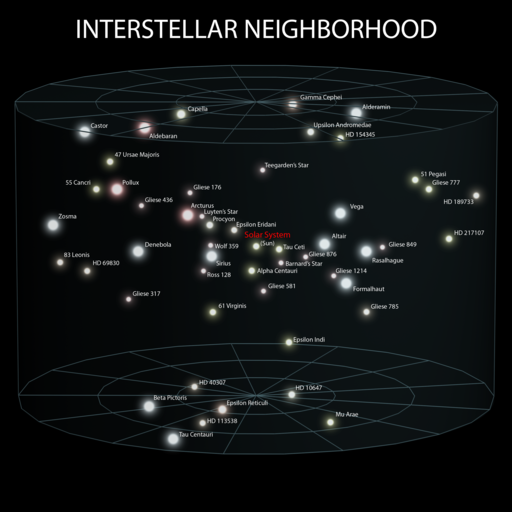


Just in the part of the universe we can see, there are over 100 billion galaxies and the approximate diameter of the known universe is 92 billion light-years. The diagrams below help the average person to understand how small we really are and how beautifully vast our universe is; and there are many very good reasons to believe that our known universe is just the very tip of the iceberg.


So how many stars total in the visible universe?
About 10 octillion stars (10 trillion billion stars). Writing that out gives us: 10,000,000,000,000,000,000,000,000,000. Care to start counting from "1"? Each star system has a chance at harboring life. Honestly ask yourself: what are the chances that we are the only intelligent life in all the universe? There is no rational basis to think of our own self or civilization as being especially "special." We are all interconnected with the rest of our incomprehensibly vast and diverse cosmos, and we ALL ought to start thinking and acting like it as we proceed on with our lives.
//Choosing Our Path//
Life really is an incomprehensibly vast ocean of possibility. We each are merely, drifting consciousnesses, floating independently along paths of our choosing. Occasionally, they cross paths in meaningful ways. More rarely, a couple choose to abandon the independent path they would otherwise have taken, and take a risk that the path and circumstances of the journey that they agree to share together will provide greater fulfillment and happiness. Yet, no matter the path we currently travel, we must always remember that there are an infinite many others we can choose to follow if we find our current one becoming stale or untenable....
Institutionalized human morality, in all areas of social life, is ultimately rooted in and defined by the need to inhibit the aggregated impact of the self-centric intentions and impulses of all the individuals that fall within the societal framework. Does a person knowingly act to achieve personal gain at the expense of others, or does a person seek to achieve personal growth by making the struggles of others partly their own, and investing in the betterment of all, for the sake of all? Is it not true that building a network of true friends through a well-meaning and steady application of selfless behavior brings lasting flexibility, strength, and happiness to one's life, whereas creating a network of people that are distrustful of you, through deliberately selfish behavior, begets fleeting gain and a lasting counter-effort of those wronged, whom always prevail over the selfish individual in the end? Only a dedicated effort on the part of every individual towards genuinely appreciating others and the benefits of the diversity that exists amongst us all, faithful application of active listening, proactive, routine, deep reflection about one's self and their social environment that leads to true insights, making a consistent effort to apply those insights to maximize the benefit of all, being actively compassionate and forgiving, and having a willingness to consistently establish truly well-intentioned relations with others can bring forth lasting balance, peace, and happiness throughout all of society. Is it not then in all of our own self interest to be selfless in our interactions with others and our collective social institutions? Perhaps most people lean towards selfishness because the idea that being selfless is more beneficial to themselves than being self-centered appears paradoxical, or at least counterintuitive.
//Human Perspective//
It is just incredible how self-centric humans tend to be, and how much unnecessary suffering results because of it. We are capable of so much more than we have already accomplished thus far as a civilization, because of this tendency towards self-centric thinking in the individual. Even after my perspective widened exponentially over the last several years, I still find it difficult at times to avoid self-centric thinking, but it is easier to do once you let your self accept that you are a very, very small part of a much grander picture.
Our Milky Way galaxy alone is so large it takes light, traveling at 186,000 miles/sec, 100,000-120,000 years to cross from one point on the edge of it, through the center, to the opposite edge. As a guide to the relative physical scale of the Milky Way, if it were reduced to 100 meters in diameter, the Solar System, including the hypothesized Oort cloud, would be no more than 1 mm in width, about the size of a grain of sand. There are between 100-400 billion stars in our galaxy alone, and contains at least 100 billion planets. On November 4, 2013, astronomers reported, based on Kepler space mission data, that there could be as many as 40 billion Earth-sized planets orbiting in the "habitable zones" of Sun-like stars and red dwarfs within the Milky Way Galaxy. 11 billion of these estimated planets may be orbiting sun-like stars. The oldest known star in the Milky Way is at least 13.82 billion years old and thus must have formed shortly after the Big Bang.
The Milky Way and the Andromeda Galaxy (the nearest galaxy to ours) are a binary system of giant spiral galaxies belonging to a group of 50 closely bound galaxies known as the Local Group, itself being part of the Virgo Supercluster (containing at least 100 galaxy groups and clusters within its diameter of 110 million light-years), which is itself a subcomponent of the Laniakea Supercluster (consisting of 100,000 galaxies stretched out over 520 megalight-years).


Just in the part of the universe we can see, there are over 100 billion galaxies and the approximate diameter of the known universe is 92 billion light-years. The diagrams below help the average person to understand how small we really are and how beautifully vast our universe is; and there are many very good reasons to believe that our known universe is just the very tip of the iceberg.

So how many stars total in the visible universe?
About 10 octillion stars (10 trillion billion stars). Writing that out gives us: 10,000,000,000,000,000,000,000,000,000. Care to start counting from "1"? Each star system has a chance at harboring life. Honestly ask yourself: what are the chances that we are the only intelligent life in all the universe? There is no rational basis to think of our own self or civilization as being especially "special." We are all interconnected with the rest of our incomprehensibly vast and diverse cosmos, and we ALL ought to start thinking and acting like it as we proceed on with our lives.
//Choosing Our Path//
Life really is an incomprehensibly vast ocean of possibility. We each are merely, drifting consciousnesses, floating independently along paths of our choosing. Occasionally, they cross paths in meaningful ways. More rarely, a couple choose to abandon the independent path they would otherwise have taken, and take a risk that the path and circumstances of the journey that they agree to share together will provide greater fulfillment and happiness. Yet, no matter the path we currently travel, we must always remember that there are an infinite many others we can choose to follow if we find our current one becoming stale or untenable....
"Any path is only a path, and there is no affront, to oneself or to others, in dropping it if that is what your heart tells you… Look at every path closely and deliberately. Try it as many times as you think necessary. Then ask yourself, and your self alone, one question… Does this path have a heart? If it does, the path is good; if it doesn't, it is of no use." — Carlos Castaneda (The Teachings of Don Juan)
Subscribe to:
Posts (Atom)