//Remembering What is Worth Remembering//
None of us can get through life without making serious mistakes. Most of the time we do our best to do what we think is right in an imperfect world, using the scattered pieces of information available to us, trying our hardest to make choices we think will lead to a better future--a future that is always totally unknown and unpredictable. On top of this less than ideal environment for even knowing and understanding what the right decisions to make are, our countless imperfections, our engrained impulses, our baser instincts, our unintentional short-sightedness, and the constant struggle we have within ourselves, often lead us astray. Inherently, "to error is human," and, in fact, all life in existence struggles to the make the best of things in a chaotic world and necessarily makes mistakes along the way. What is more important than the mistakes themselves is that all that can be learned from them, is, and that newfound knowledge is proactively applied to do better in the future.
Nevertheless, we cannot ignore, nor excuse the impact of, those mistakes we make that are excruciatingly painful to others and ourselves, made in our darkest hours, when it seemed there was no light to guide us as our own light had faded in the darkness of the pain and the fear. Though, were we, and those we've loved but deeply hurt, not victims of our own blind humanity in the times we were truly lost? Must we judge the character and value of a person's entire life based solely on their worst errors?
Can we accept that we all share, among a great many other things, the common experience of inducing pain and sorrow we never wanted for ourselves or our loved ones? Can we all agree 'we are not magnificent'--that with all our natural flaws, whether they include in any particular person a mental disorder, disability, or malady, or none at all, we do our best to find a sense of happiness and safety, even if we are looking in all the wrong places? Is it not true that we all abhor living in fear, being controlled by sadness, bitterness, and regret, and that we quite often do things that seem to make us feel better in the moment but leave us just as empty as before? Is it not clear the 'human condition' is an inherent paradox, and to be human is to be a walking, talking paradox of mixed emotions and mental conflict, having only a dim perception of the real world whilst possessing dangerously limitless but immature imagination?
We all want to be loved and remembered fondly, despite the very serious, yet very human blunders we've made. I, for one, believe our best qualities and greatest achievements are the only things of value worth remembering once we are dead and gone...
//"We're Living at the Mercy of the Pain and the Fear Until We Dead It, Forget It, Let It All Disappear"//
"Yeah, yo
This is not the end, this is not the beginning
Just a voice like a riot rocking every revision
But you listen to the tone and the violent rhythm
And though the words sound steady, something empty's within 'em
We say 'Yeah', with fists flying up in the air
Like we're holding onto something that's invisible there
'Cause we're living at the mercy of the pain and the fear
Until we dead it, forget it, let it all disappear (yeah)
Waiting for the end to come, wishing I had strength to stand
This is not what I had planned, it's out of my control
Flying at the speed of light, thoughts were spinning in my head
So many things were left unsaid, it's hard to let you go
I know what it takes to move on, I know how it feels to lie
All I wanna do is trade this life for something new
Holding on to what I haven't got
Sitting in an empty room, trying to forget the past
This was never meant to last, I wish it wasn't so
I know what it takes to move on, I know how it feels to lie
All I wanna do is trade this life for something new
Holding on to what I haven't got
Yo, yeah
What was left when that fire was gone?
I thought it felt right but that right was wrong
All caught up in the eye of the storm
I'm trying to figure out what it's like moving on
And I don't even know what kind of things I said
My mouth kept moving and my mind went dead
So, picking up the pieces now, where to begin?
The hardest part of ending is starting again!
All I wanna do is trade this life for something new
Holding on to what I haven't got
This is not the end, this is not the beginning
Just a voice like a riot rocking every revision
(I'm holding on to what I haven't got)
But you listen to the tone and the violet rhythm
Though the words sound steady, something empty's within 'em
We say 'Yeah', with fists flying up in the air
Like we're holding onto something that's invisible there
(Holding on to what I haven't got)
'Cause we're living at the mercy of the pain and the fear
Until we dead it, forget it, let it all disappear"
Showing posts with label choice. Show all posts
Showing posts with label choice. Show all posts
March 8, 2016

January 13, 2015
Dichotomy, Unity, and Balance in Nature and Life
//With Respect to the Overall Nature of Existence//
All that exists is inherently a dipolar spectrum that is both "One" and simultaneously "All." It is "One" because everything that exists, exists relative to something else, and everything is interconnected with everything else, thus constituting an undivided whole. Because this undivided spectrum provides for infinite degree between its two opposite "poles" (has no division of 'intervals' along it), it is what is necessary for "All" things to have relative distinction from all other things. For anything to exist it must exist within a construct that provides the "contrast" necessary for any thing's attributes to be mathematically or physically definable; the dipolar spectrum in our universe provides this contrast, which in turn provides the capacity of things to have different attributes and relative relations to everything else.
So prolific and apparent is the dipolar nature of existence, a large group of people formulated the belief system called "Taoism" in which 'all is One whole' yet has internal distinctions ("Yin & Yang") simultaneously. I will provide you with several examples of Yin & Yang features of nature that you are already naturally familiar with: light vs. darkness, order vs. chaos, hot vs. cold, larger scales of space vs. smaller scales of space, past vs. future, mass vs. no mass, higher energy state vs. lower energy state, stronger gravity/acceleration vs. weaker gravity/acceleration, moving closer together vs. moving away from each other, "good" vs. "evil", life (animate) vs. death (inanimate), et cetera. Everything that exists has defining attributes, each of which lie somewhere along and within this dipolar spectrum geometry, whether the attributes being observed are being observed quantitatively (objectively) or qualitatively (subjectively; e.g. based on values and morals, or other form of personal perspective). It is important to reiterate that even though different things or areas within different space-time locations have these relative distinctions from everything else, due to the fact nothing exists separate from all else and that all things are completely interconnected through space-time, quantum probability waveform, and the continuous field of matter-energy content (a.k.a. a 'state' information waveform), there are no distinct thresholds that separate one thing or area of space-time from another; thus, "All is One" by definition. A perfect example of this whole concept is a "fractal," which is infinite in its scalability, has internal distinctions, yet is "One" mathematically-defined construct.
//With Respect to Human Life//
Forgive me if this seems obvious to some of you, but many people seem to seldom actively consider balance in their life, and, largely for this reason, happiness is elusive for them. I would argue that being happy is as dependent on having balance in your life as it is on having the basic necessities of life. Consider a few examples of the dichotomies that exist for humans in their life: time alone vs. time with friends and family, free time vs. productive time, strict parenting vs. lenient parenting, trusting others completely vs. protecting yourself by being paranoid/suspicious, taking care of others at the expense of self vs. devoting yourself to taking care of yourself so much it is at the expense of others, eating too many sweets vs. not enjoying any, explaining the world through logic and mathematics vs. grasping for meaning or purpose through subjective experiences that are beyond the power of reasoning to explain, worrying too much about appearance vs. not taking care of yourself, living up to others' expectations vs. acting solely based on what you believe is right and appropriate, being naive vs. being judgmental, living a very sheltered life vs. constantly exposing yourself to situations with high risk to the point you must struggle to stay alive, always accepting the beliefs of others vs. only valuing your own, et cetera.
I have come to instinctively recognize such dichotomies almost every day of my life for many, many years. Indeed, the duality of the human experience is so frequently apparent to me that I perceive it as being as much a 'law of nature' as gravity. A person who finds or puts themselves too far one way or the other with respect to any aspect of life defined by a dichotomous nature ultimately suffers. Achieving balance is about achieving relative harmony in your life. In the past, I personally did not have balance in my life in many areas, and I suffered continuously because of it—happiness was elusive for me because of that lack of balance and, thus, harmony.
One would think that awareness of this duality in every aspect of our lives would be enough to guide our decisions towards establishing harmony for ourselves. Yet, it is one of humanity's greatest flaws that we constantly struggle with our own selves in trying to follow the "better" path (if we are fortunate enough to recognize it) because of our instinctive impulses, other engrained behaviors, and having to balance our efforts in achieving balance in our own life with helping achieve balance within our society, which often naturally conflict with one another. We often find some excuse, some weak justification, for not taking the path we know deep down, almost subconsciously, to be more beneficial to us and/or society. Why? Is it possible that part of the reason is that we define our existence to some extent through our suffering—that we need suffering as much as happiness to feel alive? Or do we simply not always have the courage to move beyond the status quo? Unfortunately, although I have a great deal of objective knowledge and subjective experience on this topic, I have not come to a complete conclusion about such matters. Maybe the "answer" is inherently different for everyone. What's yours?
All that exists is inherently a dipolar spectrum that is both "One" and simultaneously "All." It is "One" because everything that exists, exists relative to something else, and everything is interconnected with everything else, thus constituting an undivided whole. Because this undivided spectrum provides for infinite degree between its two opposite "poles" (has no division of 'intervals' along it), it is what is necessary for "All" things to have relative distinction from all other things. For anything to exist it must exist within a construct that provides the "contrast" necessary for any thing's attributes to be mathematically or physically definable; the dipolar spectrum in our universe provides this contrast, which in turn provides the capacity of things to have different attributes and relative relations to everything else.
So prolific and apparent is the dipolar nature of existence, a large group of people formulated the belief system called "Taoism" in which 'all is One whole' yet has internal distinctions ("Yin & Yang") simultaneously. I will provide you with several examples of Yin & Yang features of nature that you are already naturally familiar with: light vs. darkness, order vs. chaos, hot vs. cold, larger scales of space vs. smaller scales of space, past vs. future, mass vs. no mass, higher energy state vs. lower energy state, stronger gravity/acceleration vs. weaker gravity/acceleration, moving closer together vs. moving away from each other, "good" vs. "evil", life (animate) vs. death (inanimate), et cetera. Everything that exists has defining attributes, each of which lie somewhere along and within this dipolar spectrum geometry, whether the attributes being observed are being observed quantitatively (objectively) or qualitatively (subjectively; e.g. based on values and morals, or other form of personal perspective). It is important to reiterate that even though different things or areas within different space-time locations have these relative distinctions from everything else, due to the fact nothing exists separate from all else and that all things are completely interconnected through space-time, quantum probability waveform, and the continuous field of matter-energy content (a.k.a. a 'state' information waveform), there are no distinct thresholds that separate one thing or area of space-time from another; thus, "All is One" by definition. A perfect example of this whole concept is a "fractal," which is infinite in its scalability, has internal distinctions, yet is "One" mathematically-defined construct.
//With Respect to Human Life//
Forgive me if this seems obvious to some of you, but many people seem to seldom actively consider balance in their life, and, largely for this reason, happiness is elusive for them. I would argue that being happy is as dependent on having balance in your life as it is on having the basic necessities of life. Consider a few examples of the dichotomies that exist for humans in their life: time alone vs. time with friends and family, free time vs. productive time, strict parenting vs. lenient parenting, trusting others completely vs. protecting yourself by being paranoid/suspicious, taking care of others at the expense of self vs. devoting yourself to taking care of yourself so much it is at the expense of others, eating too many sweets vs. not enjoying any, explaining the world through logic and mathematics vs. grasping for meaning or purpose through subjective experiences that are beyond the power of reasoning to explain, worrying too much about appearance vs. not taking care of yourself, living up to others' expectations vs. acting solely based on what you believe is right and appropriate, being naive vs. being judgmental, living a very sheltered life vs. constantly exposing yourself to situations with high risk to the point you must struggle to stay alive, always accepting the beliefs of others vs. only valuing your own, et cetera.
I have come to instinctively recognize such dichotomies almost every day of my life for many, many years. Indeed, the duality of the human experience is so frequently apparent to me that I perceive it as being as much a 'law of nature' as gravity. A person who finds or puts themselves too far one way or the other with respect to any aspect of life defined by a dichotomous nature ultimately suffers. Achieving balance is about achieving relative harmony in your life. In the past, I personally did not have balance in my life in many areas, and I suffered continuously because of it—happiness was elusive for me because of that lack of balance and, thus, harmony.
One would think that awareness of this duality in every aspect of our lives would be enough to guide our decisions towards establishing harmony for ourselves. Yet, it is one of humanity's greatest flaws that we constantly struggle with our own selves in trying to follow the "better" path (if we are fortunate enough to recognize it) because of our instinctive impulses, other engrained behaviors, and having to balance our efforts in achieving balance in our own life with helping achieve balance within our society, which often naturally conflict with one another. We often find some excuse, some weak justification, for not taking the path we know deep down, almost subconsciously, to be more beneficial to us and/or society. Why? Is it possible that part of the reason is that we define our existence to some extent through our suffering—that we need suffering as much as happiness to feel alive? Or do we simply not always have the courage to move beyond the status quo? Unfortunately, although I have a great deal of objective knowledge and subjective experience on this topic, I have not come to a complete conclusion about such matters. Maybe the "answer" is inherently different for everyone. What's yours?
January 11, 2015
Feed the Hungry
Brothers and Sisters,
I am writing today to ask you to help me make a difference in the lives of the millions of Americans who have trouble making ends meet. I'm hoping you will help me by donating to my personal fundraising campaign to help fight hunger.
Did you know that one out of every six Americans struggles with hunger? This is a problem people of all ages and backgrounds face across the country. Hardworking people struggle to put food on the table for their families, and the government programs designed to help these individuals cannot close the gap.
I believe that the primary thing standing in the way of ending hunger right now is people's inclination to be apathetic towards issues they'd rather not think about. Even those who think about and talk about such problems as ending childhood hunger rarely take direct action to actually help address the problem.
In the words of the current Dalai Lama, "To meet the challenges of this century, human beings will have to develop a greater sense of universal responsibility." This universal responsibility we all share for our collective welfare requires ACTION on the part of each person, not just talk, and especially not ignoring that a particular problem exists. There is no excuse for 1 in 5 children in America to face hunger on a regular basis. We each have a social and moral obligation to ACT to resolve this unacceptable situation. Supporting this food drive is an action on your part that will have a direct impact on reducing hunger in America, the last place on Earth that should have such a problem in the first place.
That is why I've created a Virtual Food Drive for Feeding America. I'm trying to raise $100 to help Feeding America provide nutritious and much-needed food to families battling hunger. I have already donated $10 to the fundraiser. Every dollar I raise in my Virtual Food Drive will help provide 10 meals to hungry families.
Please donate to my Virtual Food Drive today and, just as importantly, spread the word about it!
http://help.feedingamerica.org/goto/wisefromwithin
Your Hungry Brothers and Sisters Thank You for Your Support,
Matthew L. Morgan
"wisefromwithin"
I am writing today to ask you to help me make a difference in the lives of the millions of Americans who have trouble making ends meet. I'm hoping you will help me by donating to my personal fundraising campaign to help fight hunger.
Did you know that one out of every six Americans struggles with hunger? This is a problem people of all ages and backgrounds face across the country. Hardworking people struggle to put food on the table for their families, and the government programs designed to help these individuals cannot close the gap.
I believe that the primary thing standing in the way of ending hunger right now is people's inclination to be apathetic towards issues they'd rather not think about. Even those who think about and talk about such problems as ending childhood hunger rarely take direct action to actually help address the problem.
In the words of the current Dalai Lama, "To meet the challenges of this century, human beings will have to develop a greater sense of universal responsibility." This universal responsibility we all share for our collective welfare requires ACTION on the part of each person, not just talk, and especially not ignoring that a particular problem exists. There is no excuse for 1 in 5 children in America to face hunger on a regular basis. We each have a social and moral obligation to ACT to resolve this unacceptable situation. Supporting this food drive is an action on your part that will have a direct impact on reducing hunger in America, the last place on Earth that should have such a problem in the first place.
That is why I've created a Virtual Food Drive for Feeding America. I'm trying to raise $100 to help Feeding America provide nutritious and much-needed food to families battling hunger. I have already donated $10 to the fundraiser. Every dollar I raise in my Virtual Food Drive will help provide 10 meals to hungry families.
Please donate to my Virtual Food Drive today and, just as importantly, spread the word about it!
http://help.feedingamerica.org/goto/wisefromwithin
Your Hungry Brothers and Sisters Thank You for Your Support,
Matthew L. Morgan
"wisefromwithin"
December 26, 2014
Insights from "Man's Search for Meaning" by Viktor E. Frankl
[Book Section 1 of 2: "Experiences in a Concentration Camp"]
-Book is an answer to: "How was everyday life in a concentration camp reflected in the mind of the average prisoner?
-Concerned not with the main figures, but of the xp. of the unknown and unrecorded victims.
-Capos: prisoner leaders; fed decently; often more brutal to reg. prisoners than the SS; demoted if "ineffective".
-Stripped of identity; known by number; prisoner numbers, not qualities mattered.
-Moral/ethical debate nonexistent, only the instinct to survive; only the most cutthroat saved themselves at the expense of others.
-"These former prisoners often say, 'We dislike talking about our experiences. No explanations are needed for those who have been inside, and the others will understand neither how we felt then nor how we feel now.'"
-Three phases: initial period of admission (into camp), distinguished by shock; the period when well entrenched in camp routine; the period following release/liberation.
-"Delusion of reprieve": condemned man has the illusion that he might be reprieved at the very last minute.
-Consequential decisions (even life-and-death) treated with no regard or seriousness by the decision-makers.
-Stripped of any connection to former life; only had 'naked' existence.
-A grim humor developed (only thing that could now be taken was their life); affords an aloofness and ability to rise above any situation.
-A curiosity over the fate to be befallen; a objective detachment as a means of protection.
-The thought of suicide was widely entertained due in part to the hopelessness of the situation.
-The fear of death subsides after the first few days.
-"An abnormal reaction to an abnormal situation is normal behavior."
-Entering the second phase, a "phase of relative apathy in which he achieved a kind of emotional death," a self-defense mechanism characterized by blunted feelings, unmoved by the suffering around him.
-"It is the mental agony caused by the injustice, the unreasonableness of it all," that "hurts the most."
-Insult is more rousing of indignation than the cruelty or pain itself.
-"Regression" occurred in camp inmates - a retreat to a more primitive form of mental life, characterized by very simple wishes and desires.
-How helpful is it to dwell on imaginings of good food when you've adapted to poor food (applies to other things as well), "for the sake of knowing that the sub-human existence which had made us unable to think of anything other than food, would at last cease"; more harmful than helpful?
-"...my body, is really a corpse already"; great mass of human flesh behind barbed wire, crowded into a few huts, which rots daily because it has become lifeless.
-When in an austere environment, seemingly small decisions about how to deal with circumstances end up having a profound impact on a person's mental state and willpower.
-"The truth - that love is the ultimate and the highest goal to which man can aspire. ...The salvation of man is through love and in love."
-"I understood how a man who has nothing left in this world still may know bliss.... In a position of utter desolation, when man cannot express himself in positive action, when his only achievement may consist in enduring his sufferings in the right way - an honorable way - in such a position man can, through loving contemplation of the image he carries of his beloved, achieve fulfillment."
-"Love goes very far beyond the physical person of the beloved. It finds its deepest meaning in his spiritual being, his inner self. Whether or not he is actually present, whether or not he is still alive at all, ceases somehow to be of importance."
-The prisoner finds refuge from the emptiness, desolation and spiritual poverty of his existence by escaping into the past, finding solace in nostalgic memories.
-An appreciation of the beauty of art and nature develops far more than ever before.
-Meaning is found in the smallest of significances.
-"...suffering completely fills (disperses through) the human soul and conscious mind, no matter whether the suffering is great or little."
-In such difficult situations "a very trifling thing can cause the greatest of joys"; "grateful for the smallest of mercies".
-Comparisons of wellbeing and luck were strictly relative to the experience of the person making the comparisons.
-"Freedom from suffering" was the primary source of any relative 'happiness'.
-"Under the influence of a world which no longer recognized the value of human life and human dignity, which had robbed man of his will and had made him an object to be exterminated... under this influence the personal ego finally suffered a loss of values. If the man in the concentration camp did not struggle against this in a last effort to save his self-respect, he lost the feeling of being an individual, a being with a mind, with inner freedom and personal value."
-Resigned to fate, combined with a great apathy.
-Guilt at the idea of escaping the situation when all the others would not be able to.
-A continuous fluctuation between hope and despair in the last hours and days of captivity.
-"We all had once been or had fancied ourselves to be 'somebody.' Now we were treated like complete nonentities. ...Without consciously thinking about it, the average prisoner felt himself utterly degraded."
-"...everything can be taken from a man but one thing: the last of the human freedoms - to choose one's attitude in any given set of circumstances, to choose one's own way."
-"...there were always choices to make. Every day, every hour, offered the opportunity to make a decision... which determined whether you would or would not submit to those powers which threatened to rob you of your very self, your inner freedom; which determined whether or not you would become the plaything of circumstance, renouncing freedom and dignity to become molded into the form of the typical inmate."
-"...in the final analysis it becomes clear that the sort of person the prisoner became was the result of an inner decision, and not the result of camp influences alone. Fundamentally... any man can, even under such circumstances, decide what shall become of him - mentally and spiritually. He may retain his human dignity.... ...the last inner freedom cannot be lost. It can be said that they were worthy of their sufferings; the way they bore their suffering was a genuine inner achievement. It is this spiritual freedom - which cannot be taken away - that makes life meaningful and purposeful."
-"...there is also purpose in that life which is almost barren of both creation and enjoyment and which admits of but one possibility of high moral behavior: namely, in man's attitude to his existence, an existence restricted by external forces. ...not only creativeness and enjoyment are meaningful. If there is a meaning in life at all, then there must be a meaning in suffering. Suffering is an ineradicable part of life, even as fate and death. Without suffering and death human life cannot be complete."
-"It was impossible to foresee whether or when, if at all, this form of existence would end. ...A man who could not see the end of his 'provisional existence' was not able to aim at an ultimate goal in life. He ceased living for the future...."
-"This feeling of lifelessness was intensified by other causes: in time, it was the limitlessness of the term of imprisonment which was most acutely felt; in space, the narrow limits of the prison. Anything outside the barbed wire became remote - out of reach and, in a way, unreal."
-"Regarding our 'provisional existence' as unreal was in itself an important factor in causing the prisoners to lose their hold on life; everything in a way became pointless."
-"One could make a victory of those experiences turning life into an inner triumph, or one could ignore the challenge and simply vegetate...."
-"Emotion, which is suffering, ceases to be suffering as soon as we form a clear and precise picture of it."
-"The prisoner who had lost faith in the future - his future - was doomed. With his loss of belief in the future, he also lost his spiritual hold; he let himself decline and became subject to mental and physical decay."
-Nietzsche: "He who has a why to live for can bear with almost any how."
-"We needed to stop asking about the meaning of life, and instead to think of ourselves as those who were being questioned by life.... Our answer must consist, not in talk and meditation, but in right action and in right conduct."
-"He will have to acknowledge the fact that even in suffering he is unique and alone in the universe. No one can relieve him of his suffering or suffer in his place. His unique opportunity lies in the way in which he bears his burden."
-"When the impossibility of replacing a person is realized, it allows the responsibility which a man has for his existence and its continuance to appear in all its magnitude. A man who becomes conscious of the responsibility he bears toward a human being who affectionately waits for him, or to an unfinished work, will never be able to throw away his life."
-"Not only our experiences, but all we have done, whatever great thoughts we may have had, and all we have suffered, all this is not lost, though it is past; we have brought it into being."
-"'Freedom' - we repeated to ourselves, and yet we could not grasp it. ...Its reality did not penetrate into our consciousness; we could not grasp the fact that freedom was ours. ...Everything appeared unreal, unlikely, as in a dream. We could not believe it was true."
-"...no one has the right to do wrong, not even if wrong has been done to them."
-"A man who for years had thought he had reached the absolute limit of all possible suffering now found that suffering has no limits, and that he could suffer still more, and still more intensely."
-"We were not hoping for happiness.... And yet we were not prepared for unhappiness."
-"...for every one of the liberated prisoners, the day comes when, looking back on his camp experiences, he can no longer understand how he endured it all. As the day of his liberation eventually came, when everything seemed to him like a beautiful dream, so also the day comes when all his camp experiences seem to him nothing but a nightmare."
-Book is an answer to: "How was everyday life in a concentration camp reflected in the mind of the average prisoner?
-Concerned not with the main figures, but of the xp. of the unknown and unrecorded victims.
-Capos: prisoner leaders; fed decently; often more brutal to reg. prisoners than the SS; demoted if "ineffective".
-Stripped of identity; known by number; prisoner numbers, not qualities mattered.
-Moral/ethical debate nonexistent, only the instinct to survive; only the most cutthroat saved themselves at the expense of others.
-"These former prisoners often say, 'We dislike talking about our experiences. No explanations are needed for those who have been inside, and the others will understand neither how we felt then nor how we feel now.'"
-Three phases: initial period of admission (into camp), distinguished by shock; the period when well entrenched in camp routine; the period following release/liberation.
-"Delusion of reprieve": condemned man has the illusion that he might be reprieved at the very last minute.
-Consequential decisions (even life-and-death) treated with no regard or seriousness by the decision-makers.
-Stripped of any connection to former life; only had 'naked' existence.
-A grim humor developed (only thing that could now be taken was their life); affords an aloofness and ability to rise above any situation.
-A curiosity over the fate to be befallen; a objective detachment as a means of protection.
-The thought of suicide was widely entertained due in part to the hopelessness of the situation.
-The fear of death subsides after the first few days.
-"An abnormal reaction to an abnormal situation is normal behavior."
-Entering the second phase, a "phase of relative apathy in which he achieved a kind of emotional death," a self-defense mechanism characterized by blunted feelings, unmoved by the suffering around him.
-"It is the mental agony caused by the injustice, the unreasonableness of it all," that "hurts the most."
-Insult is more rousing of indignation than the cruelty or pain itself.
-"Regression" occurred in camp inmates - a retreat to a more primitive form of mental life, characterized by very simple wishes and desires.
-How helpful is it to dwell on imaginings of good food when you've adapted to poor food (applies to other things as well), "for the sake of knowing that the sub-human existence which had made us unable to think of anything other than food, would at last cease"; more harmful than helpful?
-"...my body, is really a corpse already"; great mass of human flesh behind barbed wire, crowded into a few huts, which rots daily because it has become lifeless.
-When in an austere environment, seemingly small decisions about how to deal with circumstances end up having a profound impact on a person's mental state and willpower.
-"The truth - that love is the ultimate and the highest goal to which man can aspire. ...The salvation of man is through love and in love."
-"I understood how a man who has nothing left in this world still may know bliss.... In a position of utter desolation, when man cannot express himself in positive action, when his only achievement may consist in enduring his sufferings in the right way - an honorable way - in such a position man can, through loving contemplation of the image he carries of his beloved, achieve fulfillment."
-"Love goes very far beyond the physical person of the beloved. It finds its deepest meaning in his spiritual being, his inner self. Whether or not he is actually present, whether or not he is still alive at all, ceases somehow to be of importance."
-The prisoner finds refuge from the emptiness, desolation and spiritual poverty of his existence by escaping into the past, finding solace in nostalgic memories.
-An appreciation of the beauty of art and nature develops far more than ever before.
-Meaning is found in the smallest of significances.
-"...suffering completely fills (disperses through) the human soul and conscious mind, no matter whether the suffering is great or little."
-In such difficult situations "a very trifling thing can cause the greatest of joys"; "grateful for the smallest of mercies".
-Comparisons of wellbeing and luck were strictly relative to the experience of the person making the comparisons.
-"Freedom from suffering" was the primary source of any relative 'happiness'.
-"Under the influence of a world which no longer recognized the value of human life and human dignity, which had robbed man of his will and had made him an object to be exterminated... under this influence the personal ego finally suffered a loss of values. If the man in the concentration camp did not struggle against this in a last effort to save his self-respect, he lost the feeling of being an individual, a being with a mind, with inner freedom and personal value."
-Resigned to fate, combined with a great apathy.
-Guilt at the idea of escaping the situation when all the others would not be able to.
-A continuous fluctuation between hope and despair in the last hours and days of captivity.
-"We all had once been or had fancied ourselves to be 'somebody.' Now we were treated like complete nonentities. ...Without consciously thinking about it, the average prisoner felt himself utterly degraded."
-"...everything can be taken from a man but one thing: the last of the human freedoms - to choose one's attitude in any given set of circumstances, to choose one's own way."
-"...there were always choices to make. Every day, every hour, offered the opportunity to make a decision... which determined whether you would or would not submit to those powers which threatened to rob you of your very self, your inner freedom; which determined whether or not you would become the plaything of circumstance, renouncing freedom and dignity to become molded into the form of the typical inmate."
-"...in the final analysis it becomes clear that the sort of person the prisoner became was the result of an inner decision, and not the result of camp influences alone. Fundamentally... any man can, even under such circumstances, decide what shall become of him - mentally and spiritually. He may retain his human dignity.... ...the last inner freedom cannot be lost. It can be said that they were worthy of their sufferings; the way they bore their suffering was a genuine inner achievement. It is this spiritual freedom - which cannot be taken away - that makes life meaningful and purposeful."
-"...there is also purpose in that life which is almost barren of both creation and enjoyment and which admits of but one possibility of high moral behavior: namely, in man's attitude to his existence, an existence restricted by external forces. ...not only creativeness and enjoyment are meaningful. If there is a meaning in life at all, then there must be a meaning in suffering. Suffering is an ineradicable part of life, even as fate and death. Without suffering and death human life cannot be complete."
-"It was impossible to foresee whether or when, if at all, this form of existence would end. ...A man who could not see the end of his 'provisional existence' was not able to aim at an ultimate goal in life. He ceased living for the future...."
-"This feeling of lifelessness was intensified by other causes: in time, it was the limitlessness of the term of imprisonment which was most acutely felt; in space, the narrow limits of the prison. Anything outside the barbed wire became remote - out of reach and, in a way, unreal."
-"Regarding our 'provisional existence' as unreal was in itself an important factor in causing the prisoners to lose their hold on life; everything in a way became pointless."
-"One could make a victory of those experiences turning life into an inner triumph, or one could ignore the challenge and simply vegetate...."
-"Emotion, which is suffering, ceases to be suffering as soon as we form a clear and precise picture of it."
-"The prisoner who had lost faith in the future - his future - was doomed. With his loss of belief in the future, he also lost his spiritual hold; he let himself decline and became subject to mental and physical decay."
-Nietzsche: "He who has a why to live for can bear with almost any how."
-"We needed to stop asking about the meaning of life, and instead to think of ourselves as those who were being questioned by life.... Our answer must consist, not in talk and meditation, but in right action and in right conduct."
-"He will have to acknowledge the fact that even in suffering he is unique and alone in the universe. No one can relieve him of his suffering or suffer in his place. His unique opportunity lies in the way in which he bears his burden."
-"When the impossibility of replacing a person is realized, it allows the responsibility which a man has for his existence and its continuance to appear in all its magnitude. A man who becomes conscious of the responsibility he bears toward a human being who affectionately waits for him, or to an unfinished work, will never be able to throw away his life."
-"Not only our experiences, but all we have done, whatever great thoughts we may have had, and all we have suffered, all this is not lost, though it is past; we have brought it into being."
-"'Freedom' - we repeated to ourselves, and yet we could not grasp it. ...Its reality did not penetrate into our consciousness; we could not grasp the fact that freedom was ours. ...Everything appeared unreal, unlikely, as in a dream. We could not believe it was true."
-"...no one has the right to do wrong, not even if wrong has been done to them."
-"A man who for years had thought he had reached the absolute limit of all possible suffering now found that suffering has no limits, and that he could suffer still more, and still more intensely."
-"We were not hoping for happiness.... And yet we were not prepared for unhappiness."
-"...for every one of the liberated prisoners, the day comes when, looking back on his camp experiences, he can no longer understand how he endured it all. As the day of his liberation eventually came, when everything seemed to him like a beautiful dream, so also the day comes when all his camp experiences seem to him nothing but a nightmare."
December 17, 2014
A Few Thoughts Concerning the Human Condition
//Society and the Impact of Selflessness vs. Selfishness of Individuals//
Institutionalized human morality, in all areas of social life, is ultimately rooted in and defined by the need to inhibit the aggregated impact of the self-centric intentions and impulses of all the individuals that fall within the societal framework. Does a person knowingly act to achieve personal gain at the expense of others, or does a person seek to achieve personal growth by making the struggles of others partly their own, and investing in the betterment of all, for the sake of all? Is it not true that building a network of true friends through a well-meaning and steady application of selfless behavior brings lasting flexibility, strength, and happiness to one's life, whereas creating a network of people that are distrustful of you, through deliberately selfish behavior, begets fleeting gain and a lasting counter-effort of those wronged, whom always prevail over the selfish individual in the end? Only a dedicated effort on the part of every individual towards genuinely appreciating others and the benefits of the diversity that exists amongst us all, faithful application of active listening, proactive, routine, deep reflection about one's self and their social environment that leads to true insights, making a consistent effort to apply those insights to maximize the benefit of all, being actively compassionate and forgiving, and having a willingness to consistently establish truly well-intentioned relations with others can bring forth lasting balance, peace, and happiness throughout all of society. Is it not then in all of our own self interest to be selfless in our interactions with others and our collective social institutions? Perhaps most people lean towards selfishness because the idea that being selfless is more beneficial to themselves than being self-centered appears paradoxical, or at least counterintuitive.
//Human Perspective//
It is just incredible how self-centric humans tend to be, and how much unnecessary suffering results because of it. We are capable of so much more than we have already accomplished thus far as a civilization, because of this tendency towards self-centric thinking in the individual. Even after my perspective widened exponentially over the last several years, I still find it difficult at times to avoid self-centric thinking, but it is easier to do once you let your self accept that you are a very, very small part of a much grander picture.
Our Milky Way galaxy alone is so large it takes light, traveling at 186,000 miles/sec, 100,000-120,000 years to cross from one point on the edge of it, through the center, to the opposite edge. As a guide to the relative physical scale of the Milky Way, if it were reduced to 100 meters in diameter, the Solar System, including the hypothesized Oort cloud, would be no more than 1 mm in width, about the size of a grain of sand. There are between 100-400 billion stars in our galaxy alone, and contains at least 100 billion planets. On November 4, 2013, astronomers reported, based on Kepler space mission data, that there could be as many as 40 billion Earth-sized planets orbiting in the "habitable zones" of Sun-like stars and red dwarfs within the Milky Way Galaxy. 11 billion of these estimated planets may be orbiting sun-like stars. The oldest known star in the Milky Way is at least 13.82 billion years old and thus must have formed shortly after the Big Bang.
The Milky Way and the Andromeda Galaxy (the nearest galaxy to ours) are a binary system of giant spiral galaxies belonging to a group of 50 closely bound galaxies known as the Local Group, itself being part of the Virgo Supercluster (containing at least 100 galaxy groups and clusters within its diameter of 110 million light-years), which is itself a subcomponent of the Laniakea Supercluster (consisting of 100,000 galaxies stretched out over 520 megalight-years).
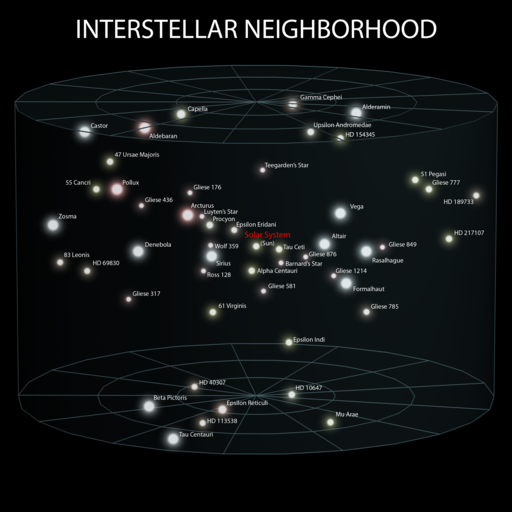


Just in the part of the universe we can see, there are over 100 billion galaxies and the approximate diameter of the known universe is 92 billion light-years. The diagrams below help the average person to understand how small we really are and how beautifully vast our universe is; and there are many very good reasons to believe that our known universe is just the very tip of the iceberg.


So how many stars total in the visible universe?
About 10 octillion stars (10 trillion billion stars). Writing that out gives us: 10,000,000,000,000,000,000,000,000,000. Care to start counting from "1"? Each star system has a chance at harboring life. Honestly ask yourself: what are the chances that we are the only intelligent life in all the universe? There is no rational basis to think of our own self or civilization as being especially "special." We are all interconnected with the rest of our incomprehensibly vast and diverse cosmos, and we ALL ought to start thinking and acting like it as we proceed on with our lives.
//Choosing Our Path//
Life really is an incomprehensibly vast ocean of possibility. We each are merely, drifting consciousnesses, floating independently along paths of our choosing. Occasionally, they cross paths in meaningful ways. More rarely, a couple choose to abandon the independent path they would otherwise have taken, and take a risk that the path and circumstances of the journey that they agree to share together will provide greater fulfillment and happiness. Yet, no matter the path we currently travel, we must always remember that there are an infinite many others we can choose to follow if we find our current one becoming stale or untenable....
Institutionalized human morality, in all areas of social life, is ultimately rooted in and defined by the need to inhibit the aggregated impact of the self-centric intentions and impulses of all the individuals that fall within the societal framework. Does a person knowingly act to achieve personal gain at the expense of others, or does a person seek to achieve personal growth by making the struggles of others partly their own, and investing in the betterment of all, for the sake of all? Is it not true that building a network of true friends through a well-meaning and steady application of selfless behavior brings lasting flexibility, strength, and happiness to one's life, whereas creating a network of people that are distrustful of you, through deliberately selfish behavior, begets fleeting gain and a lasting counter-effort of those wronged, whom always prevail over the selfish individual in the end? Only a dedicated effort on the part of every individual towards genuinely appreciating others and the benefits of the diversity that exists amongst us all, faithful application of active listening, proactive, routine, deep reflection about one's self and their social environment that leads to true insights, making a consistent effort to apply those insights to maximize the benefit of all, being actively compassionate and forgiving, and having a willingness to consistently establish truly well-intentioned relations with others can bring forth lasting balance, peace, and happiness throughout all of society. Is it not then in all of our own self interest to be selfless in our interactions with others and our collective social institutions? Perhaps most people lean towards selfishness because the idea that being selfless is more beneficial to themselves than being self-centered appears paradoxical, or at least counterintuitive.
//Human Perspective//
It is just incredible how self-centric humans tend to be, and how much unnecessary suffering results because of it. We are capable of so much more than we have already accomplished thus far as a civilization, because of this tendency towards self-centric thinking in the individual. Even after my perspective widened exponentially over the last several years, I still find it difficult at times to avoid self-centric thinking, but it is easier to do once you let your self accept that you are a very, very small part of a much grander picture.
Our Milky Way galaxy alone is so large it takes light, traveling at 186,000 miles/sec, 100,000-120,000 years to cross from one point on the edge of it, through the center, to the opposite edge. As a guide to the relative physical scale of the Milky Way, if it were reduced to 100 meters in diameter, the Solar System, including the hypothesized Oort cloud, would be no more than 1 mm in width, about the size of a grain of sand. There are between 100-400 billion stars in our galaxy alone, and contains at least 100 billion planets. On November 4, 2013, astronomers reported, based on Kepler space mission data, that there could be as many as 40 billion Earth-sized planets orbiting in the "habitable zones" of Sun-like stars and red dwarfs within the Milky Way Galaxy. 11 billion of these estimated planets may be orbiting sun-like stars. The oldest known star in the Milky Way is at least 13.82 billion years old and thus must have formed shortly after the Big Bang.
The Milky Way and the Andromeda Galaxy (the nearest galaxy to ours) are a binary system of giant spiral galaxies belonging to a group of 50 closely bound galaxies known as the Local Group, itself being part of the Virgo Supercluster (containing at least 100 galaxy groups and clusters within its diameter of 110 million light-years), which is itself a subcomponent of the Laniakea Supercluster (consisting of 100,000 galaxies stretched out over 520 megalight-years).
.png)
.png)
.png)
Just in the part of the universe we can see, there are over 100 billion galaxies and the approximate diameter of the known universe is 92 billion light-years. The diagrams below help the average person to understand how small we really are and how beautifully vast our universe is; and there are many very good reasons to believe that our known universe is just the very tip of the iceberg.

So how many stars total in the visible universe?
About 10 octillion stars (10 trillion billion stars). Writing that out gives us: 10,000,000,000,000,000,000,000,000,000. Care to start counting from "1"? Each star system has a chance at harboring life. Honestly ask yourself: what are the chances that we are the only intelligent life in all the universe? There is no rational basis to think of our own self or civilization as being especially "special." We are all interconnected with the rest of our incomprehensibly vast and diverse cosmos, and we ALL ought to start thinking and acting like it as we proceed on with our lives.
//Choosing Our Path//
Life really is an incomprehensibly vast ocean of possibility. We each are merely, drifting consciousnesses, floating independently along paths of our choosing. Occasionally, they cross paths in meaningful ways. More rarely, a couple choose to abandon the independent path they would otherwise have taken, and take a risk that the path and circumstances of the journey that they agree to share together will provide greater fulfillment and happiness. Yet, no matter the path we currently travel, we must always remember that there are an infinite many others we can choose to follow if we find our current one becoming stale or untenable....
"Any path is only a path, and there is no affront, to oneself or to others, in dropping it if that is what your heart tells you… Look at every path closely and deliberately. Try it as many times as you think necessary. Then ask yourself, and your self alone, one question… Does this path have a heart? If it does, the path is good; if it doesn't, it is of no use." — Carlos Castaneda (The Teachings of Don Juan)
Subscribe to:
Posts (Atom)